Last updated: November 2026
Key takeaways
- The K-12 curriculum development process runs in six stages: map the standards, set the scope and sequence, write lessons, build assessments, review, and deliver. Each stage hands a signed-off document to the next.
- Alignment is proven by traceability, not tags. Build a correlation that links each standard to the exact lessons, tasks and items that teach and assess it.
- External reviewers such as EdReports check standards alignment before usability, so weak alignment can stop a program before its classroom design is even rated.
- Accessibility belongs in the first draft. The ADA Title II web rule requires WCAG 2.1 AA for US public entities, with compliance dates in April 2027 or April 2028.
- Effort depends on grade span, standards sets, original writing, media, review rounds and accessibility level. Use the STAIRS checklist to quality-check every stage.
The K-12 curriculum development process decides whether a program passes adoption review and works in real classrooms. Skip or rush a stage and you get lessons that look aligned but fail review, a pacing guide teachers cannot finish, or digital content that breaks accessibility rules.
This guide is for product, editorial and curriculum leads at US and UK publishers, EdTech companies and districts. You get each stage from standards map to delivery, what a scope and sequence must record, the STAIRS checklist for checking quality at every stage, the drivers of effort, and the mistakes to avoid.
Planning a unit or a full course? Send us one chapter to pilot and we will come back with a scoped quote.
What is the K-12 curriculum development process?
The K-12 curriculum development process is how a team turns standards into a program teachers can use. It decides what students learn, in what order, and how teachers will know they learned it. Its outputs are a standards map, a scope and sequence, lessons, assessments, teacher guides and the alignment evidence that ties them together.
Three kinds of teams run this process. Publishers build new programs and revise existing ones. EdTech companies need course content that fits their platform, item types and data model. Districts and school networks write local units, intervention paths or adaptations of an adopted program.
The work is broader than writing pages. Curriculum development designs the learning path. Content development produces assets inside a structure someone else already designed. If you are building university courses instead, our guide to higher education course development covers that process.
Who does what in a K-12 curriculum build
Clear roles keep each stage moving. Small teams combine some of them, but every role below needs a named owner.
- Curriculum lead: owns the standards map, the scope and sequence and every sign-off.
- Subject writers: draft lessons and student materials to the agreed template.
- Assessment writers: write items, tasks and rubrics to the same objectives and tags as the lessons.
- Reviewers: run separate passes for accuracy, alignment, bias and sensitivity, and accessibility.
- Editors and production: apply the style guide and build print, LMS or structured-data files.
- Approvers: the publisher, product owner or district signs off each stage before the next one starts.
In short: Curriculum development designs the whole learning path, not just the pages inside it.
Which standards does a K-12 curriculum need to align to?
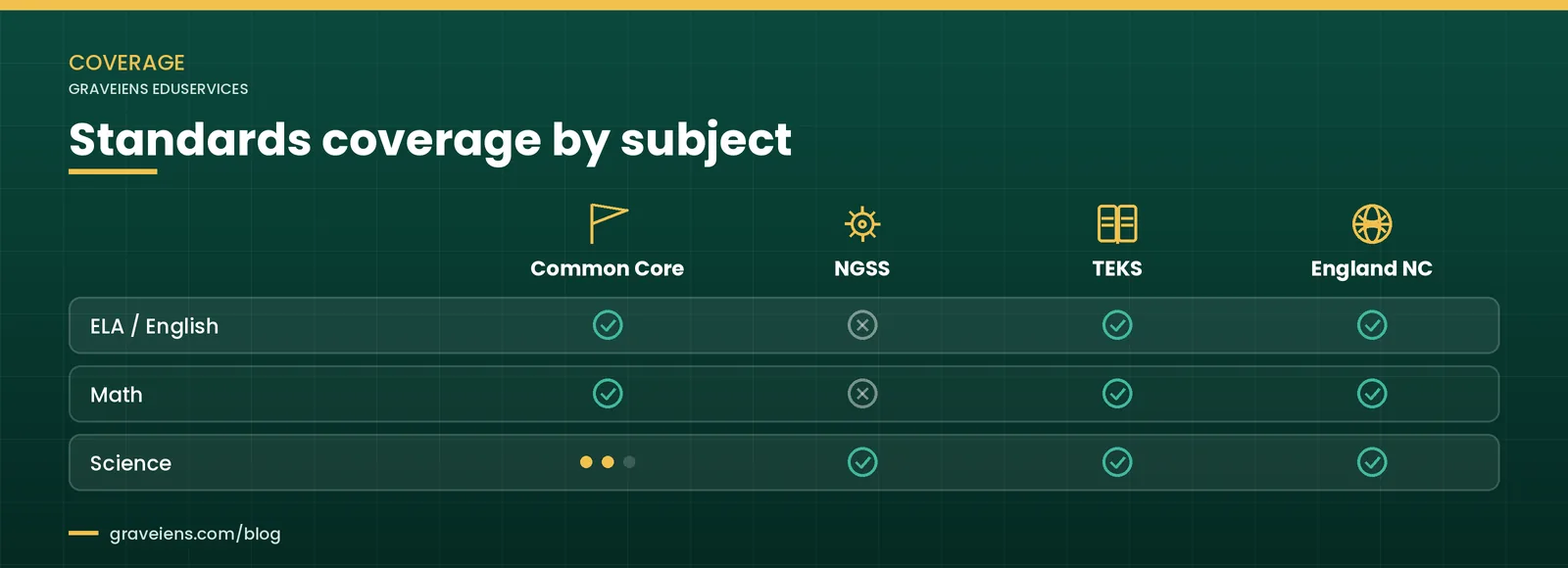
Most US programs align to Common Core for math and English language arts, to NGSS or a state version for science, and to state standards such as Texas TEKS where required. Programs for England align to the national curriculum. Multi-market programs often need several correlations, so fix the target standards sets before writing starts.
Common Core: sequence is part of alignment
The Common Core math standards were written to fix a curriculum that was “a mile wide and an inch deep.” They were built from research-based learning progressions, so the order of topics matters as much as the topics themselves.
That makes scope and sequence an alignment issue, not a formatting task. The ELA standards add College and Career Readiness anchor standards that run through every grade, so ELA units also need a clear vertical thread.
NGSS: three dimensions in every lesson
NGSS performance expectations combine three dimensions: science and engineering practices, disciplinary core ideas and crosscutting concepts. A lesson that covers the right content but skips the practice is only partly aligned.
Assessments need students to do science, not just recall it. In practice that means performance tasks, investigations and rubrics, which take longer to write and review than recall items.
State standards such as TEKS
Some states write their own standards instead of adopting Common Core or NGSS. Texas TEKS is a common example. State sets change wording, grade placement and emphasis, so a Common Core correlation cannot simply be relabeled. Each state needs its own standards map.
The national curriculum in England
The national curriculum sets the subjects and standards for primary and secondary schools in England, organized into key stages. Academies and private schools do not have to follow it, but academies must teach a broad and balanced curriculum that includes English, maths and science.
Change is coming. As of November 2026, the Department for Education says it aims to publish the final revised national curriculum by spring 2027, for first teaching from September 2028. It also says the new curriculum will be digital and machine-readable. UK publishers planning revisions should build structured, taggable source files now.
In short: Choose your standards sets first. Every later step, from pacing to item tags, depends on that choice.
How does the K-12 curriculum development process work, step by step?
A K-12 curriculum build moves through six stages: map the standards, set the scope and sequence, write lessons, build assessments, review, and deliver. Each stage produces a document the next stage depends on. Rushing the early stages is the most common reason programs need costly rewrites later.
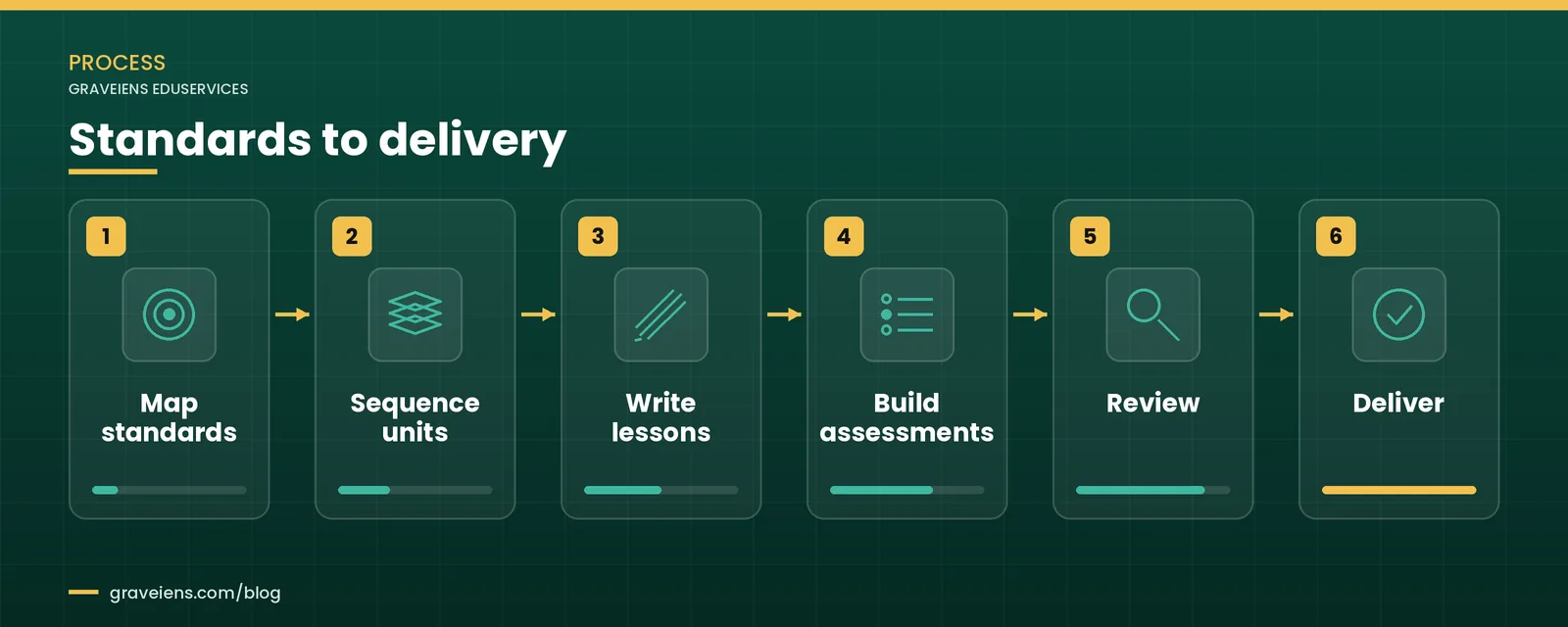
- Map the standards. Unpack each standard into learning objectives and success criteria. Note prerequisites and where a standard repeats across grades. The output is a standards map that the curriculum lead and the approver sign off.
- Set the scope and sequence. Group objectives into units, order them, and assign pacing in instructional days. Check the total against a real school calendar, including testing windows and review days.
- Write the lessons. Draft lesson plans and student materials against an agreed template and style guide. Every lesson names the objectives and standards it serves.
- Build the assessments. Write formative checks, unit assessments and performance tasks to the same objectives. Tag each item to a standard and a cognitive level. Our assessment authoring team works to the same tags as the lessons.
- Review. Run passes for subject accuracy, alignment, bias and sensitivity, accessibility and copyediting. Then route to the approver and log every change.
- Deliver. Ship print-ready files, LMS packages or structured data, together with the correlation and traceability documents.
What goes into a scope and sequence document
A scope and sequence is the contract between the standards and the classroom. These five fields catch most problems before writing starts.
| Field | What it records | Why it matters |
|---|---|---|
| Unit and topic | Title, big idea, order in the year | Shows the learning path at a glance |
| Standards | Codes taught and assessed in each unit | Basis for correlations and adoption bids |
| Pacing | Instructional days per unit and lesson | Exposes programs that cannot be finished |
| Prerequisites | Skills students need first | Prevents gaps between grades |
| Assessments | Checks and tasks per unit | Confirms every standard is measured |
Assessments deserve their own plan. For item-level detail, see our guide to question bank development, which covers tagging, item review and delivery formats.
Sign-off gates between stages
Each stage should end with a short gate review. The approver confirms the output is complete before the next team starts work on it.
Three gates matter most. Sign off the standards map before sequencing, the scope and sequence before writing, and one sample lesson with its items before full production. A sample that fails review costs a day to fix. A full unit built on the same mistake costs weeks.
In short: Six stages, each with a signed-off output. The standards map and the scope and sequence carry the most risk.
How to check quality at every stage: the STAIRS checklist
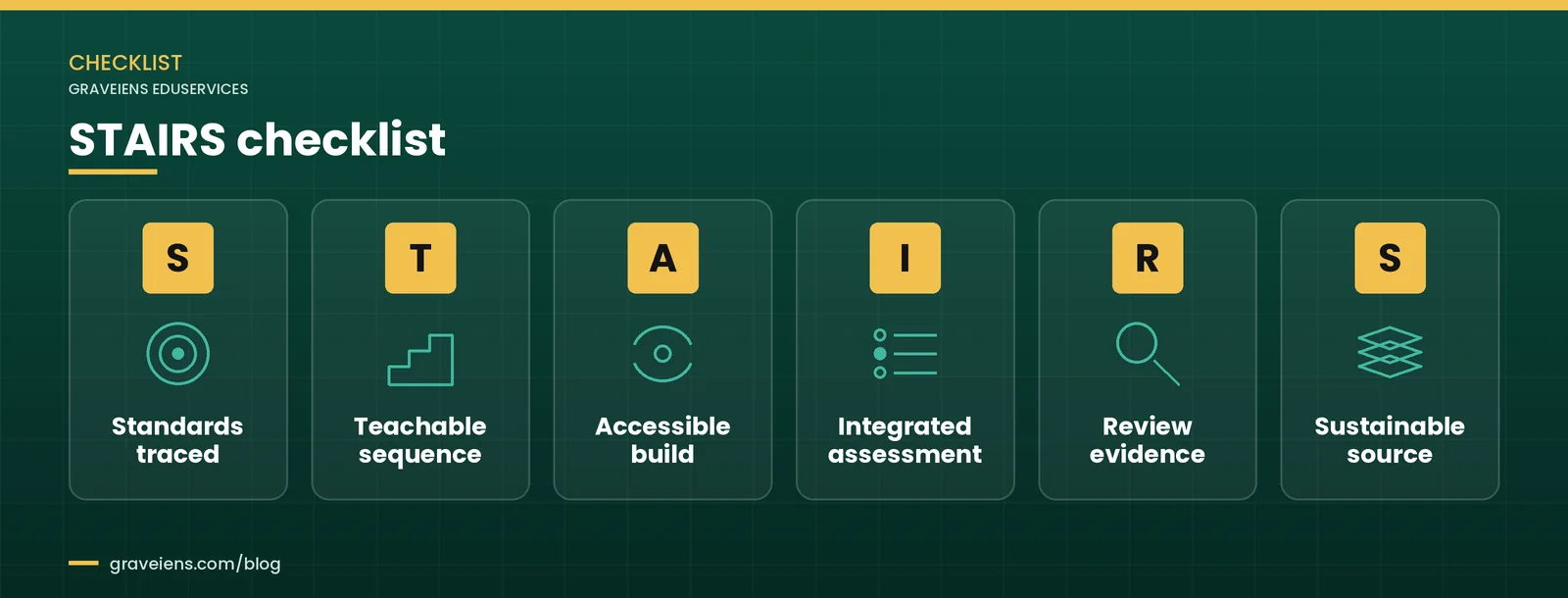
Use STAIRS as a gate check at each stage of the build. Each letter is a question your team should answer with evidence, not opinion. If you buy curriculum development services, run the same six checks on a vendor’s sample work.
S: Standards traced
Build a traceability matrix that links each standard to specific lessons, activities and assessment items. A tag list that only says a lesson “addresses” a code is weak evidence. A strong matrix shows where each standard is introduced, practiced and assessed.
T: Teachable sequence
Check pacing against a real calendar. EdReports added K-8 ELA indicators for program “bloat”, meaning more content than a teacher can cover in a school year. When the calendar says the program is too long, cut content rather than squeeze lessons.
A: Accessible build
Decide which WCAG level you build to and how you will test it. Heading structure, color contrast, captions, accessible math and alt text for STEM images belong in the lesson template, not in a fix-up pass at the end.
I: Integrated assessment
Assessments should measure the same objectives, at the same depth, as the lessons. For NGSS, that means tasks where students use a practice, not just recall a fact. Spot-check a sample of items for a standard tag and a rationale.
R: Review evidence
Decide how many review stages there are, who performs each one and what gets logged. External reviewers check alignment first. In the EdReports review tools, materials must meet requirements in one gateway before they are reviewed in the next. Run internal review in the same order.
S: Sustainable source
Keep source files structured and editable. Structured source makes reprints, platform moves and new correlations cheaper. If outside writers are involved, confirm IP transfer and editable source files in the contract. For wider vendor checks such as references and pilots, see our guide to choosing education outsourcing companies.
Want STAIRS as a one-page checklist for your next gate review? Request the STAIRS checklist, or request a free sample task to see how we trace standards in a real lesson.
What drives time and effort in curriculum development?
Effort depends on six main drivers: grade span, the number of standards sets, how much is original writing, media and interactivity, review rounds, and accessibility level. A supplemental unit for one state is a small project. A multi-grade core program correlated to several standards sets is a large one, with a longer schedule.
| Driver | Lower effort | Higher effort |
|---|---|---|
| Grade span | One grade, one subject | A K-8 or 6-12 progression |
| Standards sets | One set, such as Common Core | Several states plus England |
| Writing | Adapting existing content | Original lessons and items |
| Media and interactives | Static text and images | Video, simulations, interactive items |
| Review rounds | One approval round | Educator panels, pilots, several rounds |
| Accessibility | Basic alt text | Full WCAG AA build with testing |
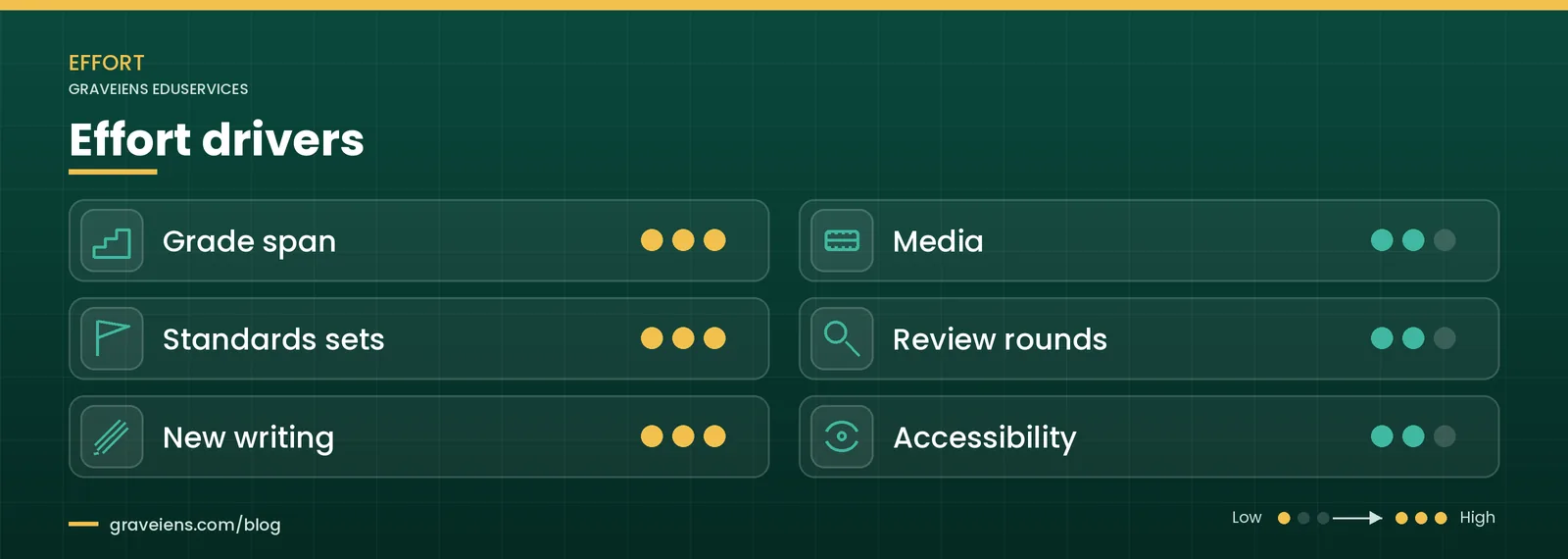
Two hidden drivers matter as much as the table. The first is a vague specification: without a fixed lesson template, item types and style guide, writers guess and reviewers rewrite. The second is a moving target, such as a new standards set added halfway through writing.
Lock the standards sets, templates and review roles before writing starts. Any schedule or budget set before those decisions is a guess, so plan the estimate after a pilot sample.
In short: Scope, not page count, sets the effort. Grade span, standards sets and original writing move it the most.
Common mistakes that derail a curriculum build
Most failed builds trace back to a handful of avoidable decisions. Watch for these seven.
- Treating alignment as tagging. Codes on a lesson prove nothing. Keep lesson-level and item-level evidence.
- Writing assessments last. When items come after lessons, they drift toward what was easy to write. Plan both from the same objectives.
- Ignoring pacing. A program with more lessons than school days forces teachers to skip content, often the hardest standards.
- Bolting accessibility on at the end. Retrofitting alt text, structure and math markup costs more than building them in.
- Running one review round. A single approval round catches surface errors but rarely misalignment or bias. Separate the passes.
- No plan for standards changes. States revise standards, and England moves to a new national curriculum from 2028. Decide now how updates will be handled.
- Losing the source files. PDFs alone lock you into reworking from scratch. Keep editable, structured source.
Accessibility rules US districts now buy against
The US Department of Justice ADA Title II rule requires web content and mobile apps from state and local government entities, which include public school districts, to meet WCAG 2.1 Level AA.
As of November 2026, ADA.gov lists compliance dates of April 26, 2027 for entities with a population of 50,000 or more, and April 26, 2028 for smaller entities and special district governments. The same guidance tells public entities to check whether their vendors can produce accessible content. Expect districts to ask publishers for that evidence, and publishers to ask the same of anyone who writes for them.
In short: Most quality failures are planning failures. Fix alignment evidence, pacing and accessibility in the specification.
How GravEiens EduServices approaches curriculum development
GravEiens EduServices follows a documented QA process with multi-level human review. Every curriculum project runs through our four-stage QA workflow: content creation, internal review, client review and final delivery. For question banks, images can be delivered embedded in JSON (Base64) for direct platform import.
To see what we build and how engagements work, visit our page on curriculum development services for K-12 schools and publishers. Projects outside our standard catalogue are welcome; we scope those with you.
Frequently asked questions
How long does it take to develop a K-12 curriculum?
It depends on scope. A single supplemental unit for one standards set usually takes weeks. A multi-grade core program runs for months across several review cycles. The biggest schedule risks are late changes to the standards target, an unfixed lesson template and slow review rounds. Agree on review turnaround times in the project plan.
What is a scope and sequence in curriculum development?
A scope and sequence is the plan that sets what is taught (scope) and in what order (sequence) across a year or grade band. It lists units, topics, standards, pacing in instructional days, prerequisites and assessments. Writers use it as their brief, and reviewers use it to check that every standard is taught and measured.
How do you prove a curriculum is standards-aligned?
Use a traceability matrix. It links each standard to the specific lessons, activities and assessment items that teach and measure it, and shows where the standard is introduced, practiced and assessed. Reviewers can then sample lessons and confirm the match. A list of standard codes on each lesson is not enough evidence.
Can one curriculum align to Common Core and state standards at the same time?
Yes, but each standards set needs its own map and correlation. Wording, grade placement and emphasis differ between sets, so a Common Core correlation cannot simply be relabeled for a state such as Texas. Plan shared core lessons with state-specific additions, and decide all target standards sets before writing begins.
What is the difference between curriculum development and instructional design?
Curriculum development decides what students learn, in what order and how learning is measured across a course or program. Instructional design focuses on how each lesson or module teaches, including activities, media and interaction. K-12 curriculum projects use both: the curriculum sets the path, and instructional design shapes each step.
What should a curriculum development plan lock in before writing starts?
Lock in the target standards sets, grade span, lesson and item templates, number of review rounds, accessibility level, delivery formats and named sign-off points. If outside writers are involved, add IP transfer, delivery of editable source files and how later standards changes will be handled. A short pilot before full production lowers risk for everyone.
Do curriculum writers need classroom experience?
Classroom experience helps writers judge pacing, misconceptions and what teachers can actually use. It is not the only safeguard. Separate subject-accuracy, alignment, bias and accessibility reviews catch issues any single writer misses. Make clear who writes, who reviews, and how reviewer feedback is logged and resolved.
How should UK publishers prepare for the new national curriculum in England?
As of November 2026, DfE aims to publish the final revised curriculum by spring 2027 for first teaching from September 2028, in a digital, machine-readable form. Publishers should audit current titles against the review recommendations, keep content in structured source files, and plan correlation updates so revised editions are ready before schools start preparing.
Ready to plan your next K-12 unit or program?
Send us one chapter or 20 items to pilot and get a scoped quote. Prefer to start with criteria? Request the STAIRS checklist for your next gate review.
Send us one chapter to pilot | Get a scoped quote | Request the STAIRS checklist
Sources
- Common Core State Standards Initiative. Mathematics Standards. https://corestandards.org/mathematics-standards/
- NGSS Lead States. How to Read the Next Generation Science Standards (2013). https://www.nextgenscience.org/sites/default/files/How%20to%20Read%20NGSS%20-%20Final%204-19-13.pdf
- EdReports. Review Tools. https://edreports.org/process/review-tools
- EdReports. Evolving EdReports’ Review Process to Meet Emerging and Future Needs (28 April 2020). https://edreports.org/resources/article/evolving-edreports-review-process-to-meet-emerging-and-future-needs
- GOV.UK. The national curriculum: overview. https://www.gov.uk/national-curriculum
- Department for Education. New curriculum to give young people the skills for life and work (4 November 2025). https://www.gov.uk/government/news/new-curriculum-to-give-young-people-the-skills-for-life-and-work
- U.S. Department of Justice, ADA.gov. First Steps Toward Complying with the ADA Title II Web and Mobile Application Accessibility Rule. https://www.ada.gov/resources/web-rule-first-steps/

 EdTech Outsourcing
EPUB Conversion Cost per Page: What Drives the Price (and How to Get an Accurate Quote)
EPUB conversion cost per page depends on source files, layout, math, images and accessibility. Score your title with our worksheet…
 EdTech Outsourcing
2D Educational Animation Services: Process, Styles, and How to Brief Them
How 2D educational animation services actually work: styles, pipeline, briefing tips, cost drivers, and mistakes to avoid before you hire…
 EdTech Outsourcing
Education Outsourcing Companies: How to Choose the Right Content Partner
Compare education outsourcing companies with the 7-point PARTNER check, a pilot-first process, cost drivers and red flags. Request a free…
Get monthly EdTech insights
Trends, content tips and how-tos — once a month, no spam.