Last updated: October 2026
Key takeaways
- Question bank development services give you finished, review-ready assessment items: stem, options, key, distractor rationales, worked solution and metadata, written to your blueprint and delivered in your import format.
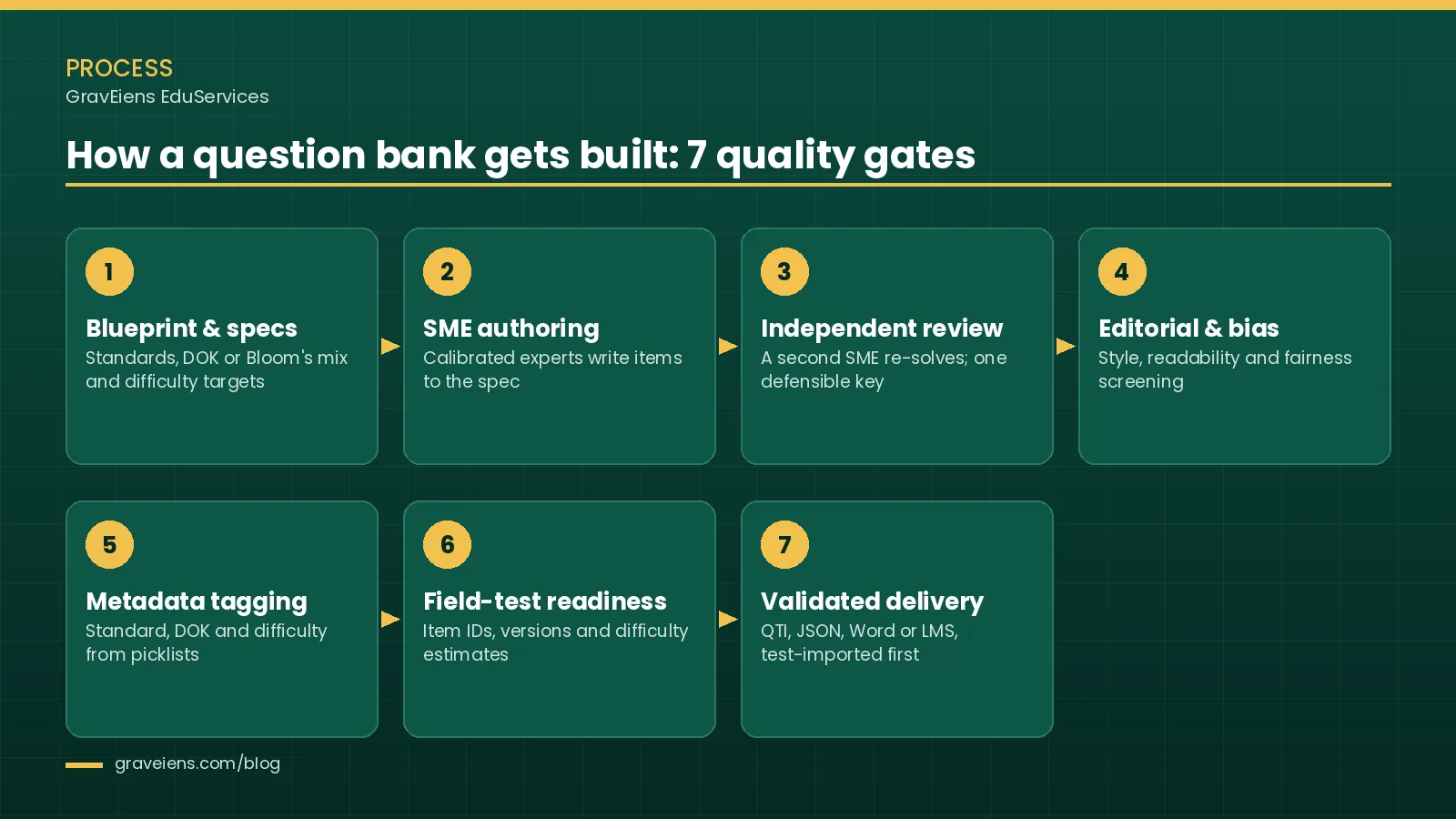
- A sound process has seven gates: blueprint, SME authoring, independent SME review, editorial and bias review, metadata tagging, field-test readiness and validated delivery (QTI, JSON, Word or LMS).
- Item type, graphics, rationale depth, review rounds, metadata depth, volume and IP terms drive cost far more than subject alone.
- Choose a vendor on evidence: a 20-item pilot scored against your rubric, a sample export that imports cleanly, and an IP assignment clause in the contract.
Your platform needs thousands of new items by next term, and your in-house writers can manage only a fraction of that. Every item must also import cleanly, map to a standard and survive a fairness review. This guide is for publishers, EdTech product teams and test-prep companies weighing question bank development services. It explains what a professional item contains, how the work should flow, which quality checks matter, what drives cost and how to compare vendors before you sign.
Planning a new bank or a refresh? Send us your blueprint and we will return 20 sample items written to your specs.
What are question bank development services?
Question bank development services are outsourced assessment item authoring: subject experts write, review, tag and package test items to a client’s blueprint. The deliverable is a structured bank of original items with answer keys, rationales, solutions and metadata, exported in a format your platform or print workflow can use without rework.
Buyers use the terms “question bank,” “item bank” and “test bank” loosely. In practice, a test bank usually ships with a textbook for instructors, an item bank is the managed store an assessment platform draws from, and a question bank covers both. The work behind them is the same: item authoring to a specification, then layers of review.
Three buyer groups commission this work most often:
- Publishers who need test bank development for new editions, ancillaries and digital courseware.
- EdTech platforms that need large, tagged banks for practice, diagnostics and adaptive engines, usually delivered as JSON or QTI.
- Test-prep companies that need exam-pattern items with full solutions and strict originality.
In short: you are buying finished, review-ready items plus the data that makes them usable, not just a list of questions.
What does a professional assessment item include?
A professional assessment item includes six parts: a clear stem, a set of options, one verified key, a rationale for each distractor, a worked solution and metadata. The metadata ties the item to a standard, cognitive level and difficulty. If any part is missing, the item is harder to review, harder to reuse and harder to report on.
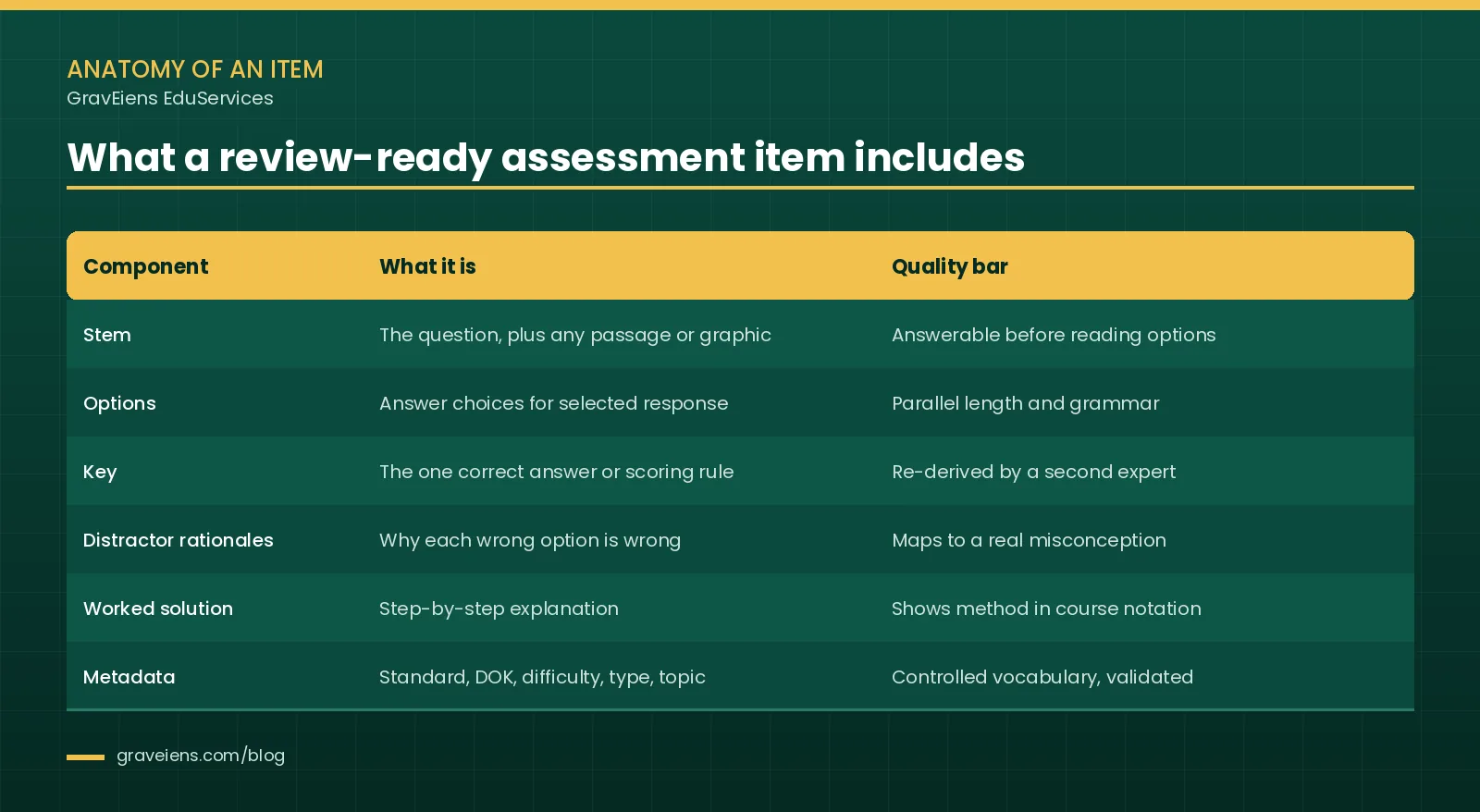
| Component | What it is | Quality bar |
|---|---|---|
| Stem | The question or task, plus any passage, data or graphic it needs | Answerable before reading the options; one idea; no unnecessary words |
| Options | The answer choices (for selected-response items) | Similar length and grammar; no “all of the above”; logical order |
| Key | The single correct answer, or the scoring rule for multi-select and constructed response | Re-derived by a second expert; defensible against appeal |
| Distractor rationales | Why each wrong option is wrong and which misconception it targets | Every distractor maps to a real error a learner makes |
| Solution | A step-by-step explanation a student can learn from | Shows method, not just the answer; matches the curriculum’s notation |
| Metadata | Tags for standard, objective, DOK or Bloom’s level, difficulty, item type, topic and status | Uses your controlled vocabulary; validated before delivery |
Distractor rationales are where cheap items fall short. They take longer to write than the key, but they turn a wrong answer into feedback and give your product team diagnostic data. Worked solutions matter just as much in test prep, where students judge a provider by its explanations.
Which item types should your question bank include?
Most banks combine single-answer multiple-choice for coverage, multi-select and technology-enhanced items for deeper skills, constructed response for reasoning and writing, and passage-based sets for reading and data analysis. The right mix follows your blueprint, delivery platform and scoring capacity, not what is fastest to write.
| Item type | Where it fits | Watch-outs |
|---|---|---|
| Multiple-choice (single answer) | Broad coverage, quick scoring, practice and diagnostics | Weak distractors make items guessable; cueing through option length |
| Multiple-select | Concepts with more than one valid feature or example | Needs a clear scoring rule (all-or-nothing or partial credit) |
| Technology-enhanced items (TEI) | Drag-and-drop, hot spot, ordering, graphing and matching tasks | Interaction must be supported by your player and export format |
| Constructed response | Short answer, numeric entry, essays and extended problems | Needs rubrics, exemplar answers and accepted-answer variants |
| Passage-based sets | Reading, science data, case studies and source analysis | Passage rights, readability control and item independence within a set |
A practical rule: decide your item types before authoring starts, because they change writer profiles, review time, export work and cost. For a refresher on matching item types to cognitive levels, see our guide to Bloom’s taxonomy verbs by level.
How does the question bank development process work?
Reliable question bank development services run in seven stages: blueprint and test specifications, SME authoring, independent SME review, editorial and bias review, metadata tagging, preparation for field testing, and validated delivery. Each stage has a named owner and a pass or fail gate, so defects are caught before they spread across thousands of items.
1. Blueprint and test specifications
The blueprint fixes what the bank must measure: standards or learning objectives, item counts per objective, item types, the cognitive-level mix (Webb’s Depth of Knowledge or Bloom’s) and the target difficulty spread. Webb’s alignment research treats depth-of-knowledge consistency as a core test of whether items match the demand of the standards they claim to measure (Webb, 1997). Good specs also include a style guide, sample items and a list of banned content.
2. SME authoring
Subject-matter experts write items against the specs. Strong teams calibrate writers first: each writer drafts a short sample set that is scored before production begins. Writers record the intended solution path and flag any item that depends on a graphic, passage or data set that needs separate rights clearance.
3. Independent SME review
A second expert, who did not write the item, solves it from scratch, confirms there is exactly one defensible key, checks alignment to the tagged standard and rates difficulty. Disagreements go back to the writer with a reason code. This is the gate that catches double keys and factual errors.
4. Editorial, bias and sensitivity review
Editors check language load, house style, notation and readability for the target grade. A bias and sensitivity review then screens for content that could disadvantage or distract any group of test takers, such as cultural assumptions, stereotypes or region-specific knowledge. The Standards for Educational and Psychological Testing (AERA, APA and NCME, 2014 edition, now open access) treat fairness as a foundation of test development, alongside validity and reliability.
5. Question bank metadata tagging
Every item gets tags from your controlled vocabulary: standard code, objective, DOK or Bloom’s level, difficulty estimate, item type, topic, sub-topic, author and review status. Question bank metadata tagging is what lets you assemble forms, run adaptive logic and report by skill. Tags are validated against a picklist, not typed freehand.
6. Psychometric readiness and field-test support
A vendor can prepare items for field testing, but cannot promise item statistics before real students respond. Preparation means unique item IDs, version control, difficulty estimates, enemy-item flags (items that clue each other) and clean form assembly. After your field test, the vendor revises or retires items that your psychometric analysis flags.
7. Delivery and validation
Items ship in the format your system imports: QTI, JSON, Word or a direct LMS build. The 1EdTech consortium lists the QTI v3.0 Final Release Specification as dated 11 May 2022. Many platforms still import QTI 2.1 packages, even though 1EdTech’s QTI page, as of October 2026, notes that QTI 2.1 product certifications expired on 31 December 2024 (1EdTech QTI). Confirm the exact version and profile your platform accepts, then test-import a sample before full delivery.
For JSON feeds, agree the schema up front: field names, how math is encoded (MathML or LaTeX), and whether images are embedded as Base64 strings or delivered as separate files with relative paths. A ten-item test import catches most schema issues in a day.
Quality checklist for assessment item authoring
Whichever provider of question bank development services you shortlist, use the eight checks below on every sample and every batch you receive. They take minutes per item once reviewers know them, and they catch most defects that reach students.
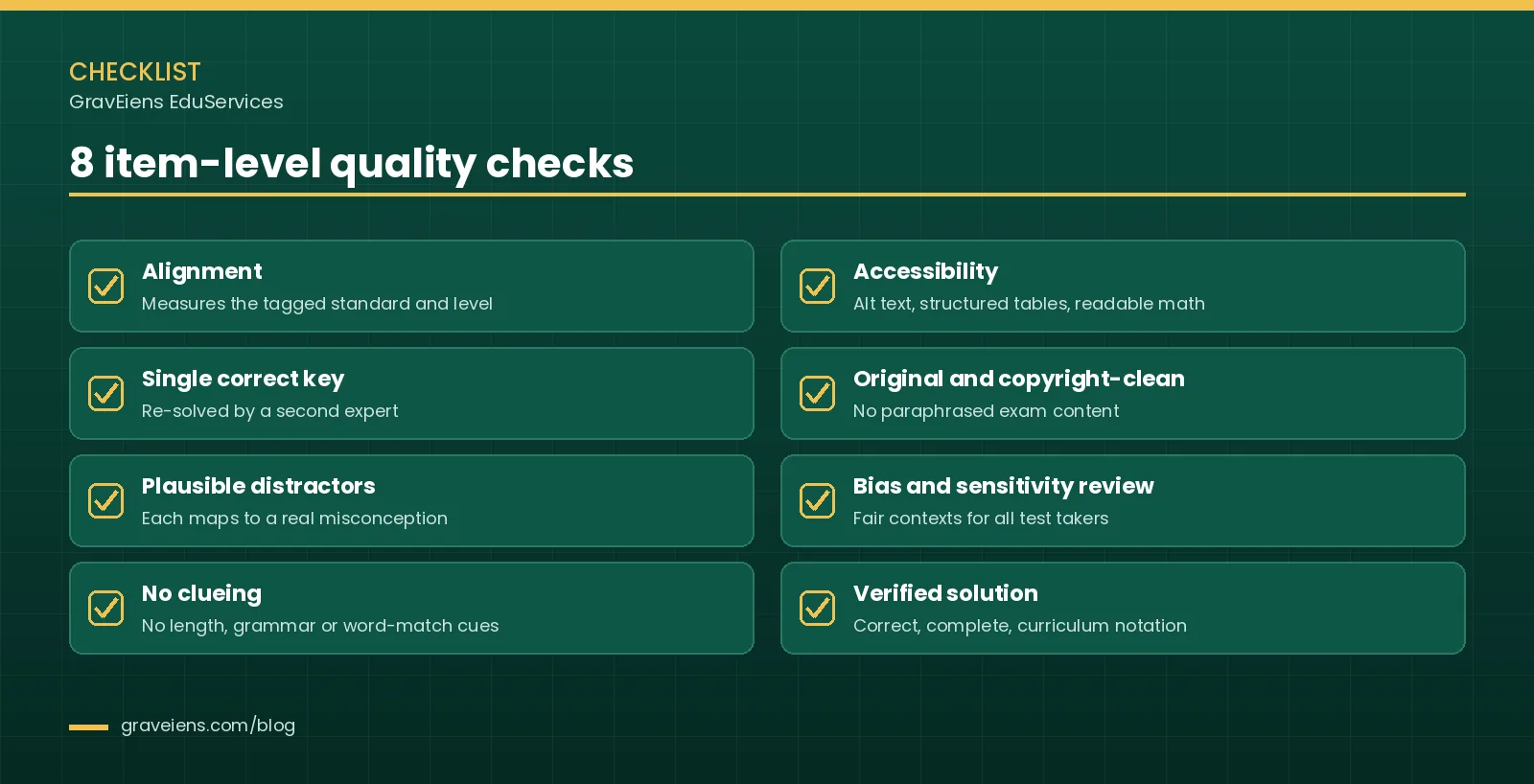
- Alignment. The item measures the tagged standard at the tagged cognitive level, not an adjacent skill.
- Single correct key. A second expert reaches the same answer independently, and no distractor can be argued as correct.
- Plausible distractors. Each wrong option reflects a real misconception and has a written rationale.
- No clueing. No grammatical cues, no longest-option keys, no repeated words between stem and key, and no item that answers another.
- Accessibility. Graphics have alt text that conveys the information needed to answer, tables are structured, and math is encoded so screen readers can read it.
- Original and copyright-clean. Items, passages and images are newly written or cleared, with no paraphrased exam content.
- Bias and sensitivity reviewed. Contexts are familiar to all target test takers and free of stereotypes.
- Verified solution. The worked solution is correct, complete and uses the notation your curriculum teaches.
For context on where these items sit in a wider assessment plan, read our explainer on summative assessment types and examples.
How much do question bank development services cost?
The cost of question bank development services depends on eight drivers: item type, subject complexity, graphics, rationale and solution depth, number of review rounds, metadata depth, volume and IP terms. Two banks with the same item count can differ widely in effort, so compare quotes on a written spec, not on a headline per-item price.
| Cost driver | Lower effort | Higher effort |
|---|---|---|
| Item type | Single-answer MCQ | TEI, constructed response with rubrics, passage-based sets |
| Subject complexity | Foundational topics, early grades | Advanced STEM, medicine, law, graduate-level content |
| Graphics | Text-only items | Original diagrams, graphs and data sets with alt text |
| Rationale and solution depth | Key only | Rationale for every distractor plus full worked solutions |
| Review rounds | One combined review | Independent SME review, editorial, bias review and client rounds |
| Metadata depth | Topic and difficulty | Multi-framework standards, DOK, objectives and custom fields |
| Volume and timeline | Steady volume on a flexible schedule | Small pilot runs or rush delivery with parallel teams |
| IP terms | Licensed or non-exclusive use | Full IP assignment, exclusivity and originality warranties |
Two drivers are often missed in early quotes for question bank development services. First, export work: a validated QTI or JSON package with embedded images takes more effort than a Word file. Second, rework after your review: agree how many client revision rounds are included and how rejected items are replaced.
Want a quote you can compare line by line? Ask us for the BANKS vendor scorecard, a one-page sheet based on the framework below, or send your blueprint for a scoped estimate.
How to choose a question bank development vendor: the BANKS framework
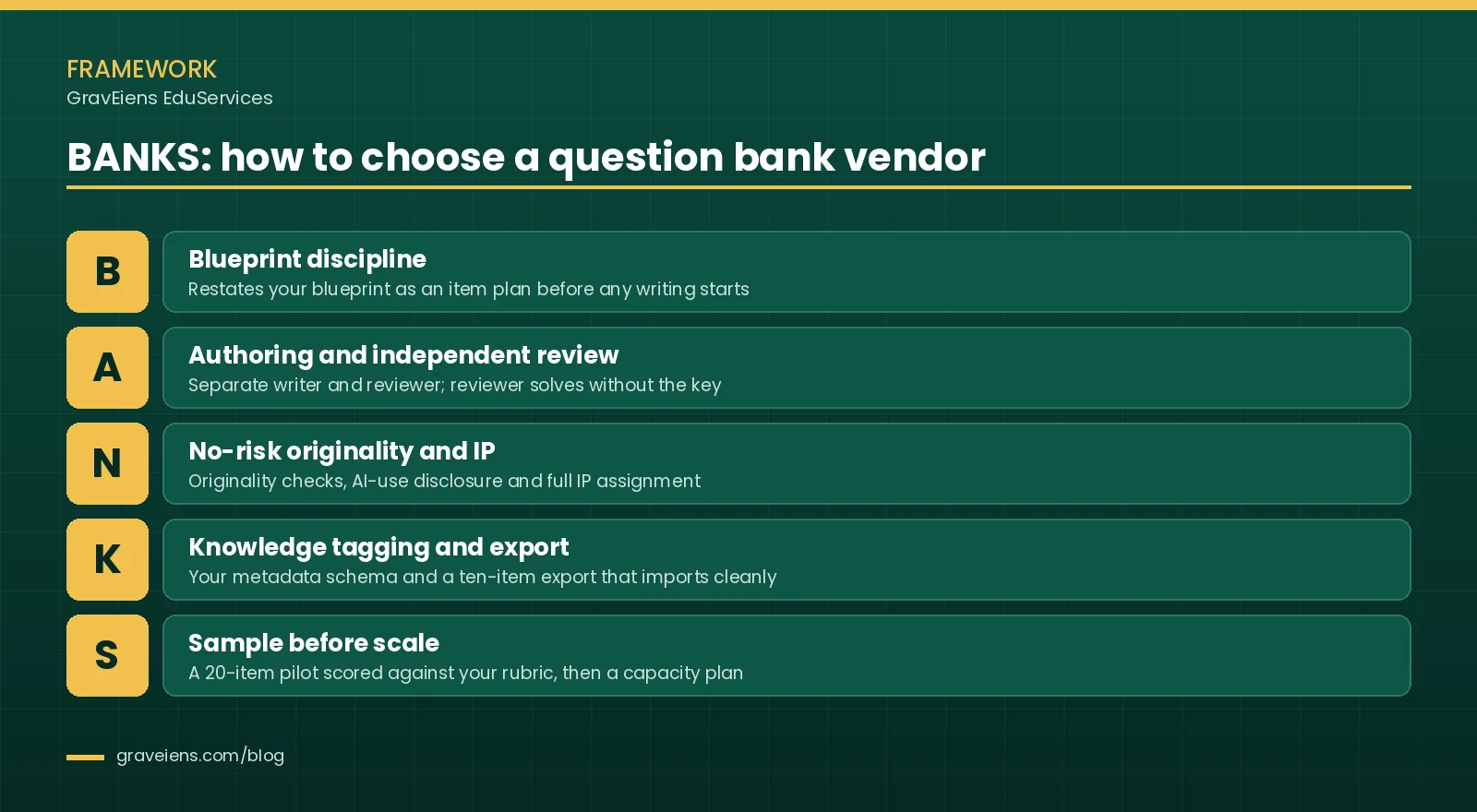
Choose a provider of question bank development services by scoring five areas: Blueprint discipline, Authoring and independent review, No-risk originality and IP, Knowledge tagging and export, and Sample before scale. Ask for evidence in each area, such as a sample spec, a reviewer log, a contract clause and a test export, rather than relying on claims in a proposal.
B: Blueprint discipline
Ask the vendor to restate your blueprint as an item plan before any writing: counts by objective, item type, DOK level and difficulty band. If they cannot produce this in the proposal stage, alignment problems will appear later.
A: Authoring and independent review
Ask who writes, who reviews and whether the reviewer solves each item without seeing the key. Request a sample reviewer log with reason codes. Item writing services that combine writing and review in one person save money and miss errors.
N: No-risk originality and IP
Ask how originality is checked, whether generative AI is used at any stage and how that is disclosed, and whether the contract assigns full IP to you. For test-prep content, require a written warranty that no item reproduces or closely paraphrases live or released exam content.
K: Knowledge tagging and export
Send your metadata schema and ask for a ten-item export in your target format. Check that it imports without manual fixes, that images render, and that tags land in the right fields. This single test removes many vendors.
S: Sample before scale
Run a pilot of about 20 items across your hardest item types and score them with the checklist above. Then ask how the vendor will scale writer capacity without losing the quality you saw in the pilot.
What changes for digital SAT question writing?
Digital SAT question writing must fit a multistage adaptive test. As of October 2026, College Board describes two sections, Reading and Writing and Math, each split into two modules. The first module mixes easy, medium and hard questions, and the second is more or less difficult depending on performance in the first.
Per College Board’s SAT structure page, Reading and Writing has 54 questions in 64 minutes and Math has 44 questions in 70 minutes. Most questions are multiple choice, and some math questions ask students to enter an answer. College Board’s section pages describe Reading and Writing as short passages, or passage pairs, each followed by a single question.
For test-prep companies buying question bank development services, that has four practical effects on authoring:
- Difficulty tagging is essential. To mimic adaptive modules, your bank needs enough items in each difficulty band for every skill, with tags you can filter on.
- One passage, one question. Reading and Writing items are short and self-contained, so passage writing becomes part of every item rather than a shared asset.
- Student-produced responses need answer rules. Math entry items need every acceptable form of the answer (fractions, decimals) listed in the key.
- Originality is non-negotiable. Items should be modeled on published specifications, never on copied or memorized test content.
Our test prep content development team writes digital SAT-style items to these rules, with difficulty tags and full solutions.
Common mistakes when outsourcing test bank development for publishers
Most question bank development services projects that go wrong trace back to one of six avoidable mistakes, and each one is cheaper to prevent than to fix:
- Starting without a blueprint. Writers fill gaps with easy recall items, and coverage drifts away from the course.
- Treating metadata as an afterthought. Retro-tagging 3,000 items costs more than tagging at authoring time.
- Skipping the test import. Format problems found at final delivery delay launches by weeks.
- Accepting keys without rationales. You lose feedback value and make reviewer disputes harder to settle.
- Leaving IP vague. Without an assignment clause, you may not own what you paid for.
- Promising statistics before field testing. Difficulty estimates are useful, but only student data confirms how an item performs.
How GravEiens EduServices builds question banks
GravEiens EduServices has delivered education content since 2017 for 350+ clients worldwide, drawing on a network of 700+ subject experts. Our question bank development services sit within our assessment item authoring services and follow an ISO 9001 certified quality system and a four-stage QA workflow:
- Content creation: calibrated SMEs write items to your blueprint, style guide and metadata schema.
- Internal review: a second SME re-solves every item, then editors run language, accessibility and bias and sensitivity checks.
- Client review: you review batches in your preferred tool, and every comment is logged and resolved.
- Final delivery: validated exports in QTI, JSON, Word or direct LMS entry, matched to your import specification. For JSON feeds, we deliver item images embedded as Base64 strings, so each item travels as one self-contained record.
Every item is original and copyright-clean, and full IP transfer is available on request. We prepare items for your field test with IDs, versioning and difficulty estimates, and we revise items your psychometric review flags. We support K-12, test prep and higher education assessment banks, and for anything outside our standard catalog, we scope it with you.
What is the difference between an item bank and a question bank?
The terms overlap. “Question bank” is the everyday term for any collection of test questions. “Item bank” is the assessment industry’s term for a managed store of items with metadata, version history and, after field testing, item statistics. A test bank is usually a set of items supplied with a textbook for instructors. All three are built with the same authoring and review process.
How much do question bank development services cost?
Cost depends on item type, subject level, graphics, rationale and solution depth, review rounds, metadata depth, volume, timeline and IP terms. A text-only MCQ with a key costs far less to produce than a technology-enhanced item with original graphics, full rationales and multi-framework tags. Ask vendors to quote against the same written spec so you can compare like for like.
How long does it take to build a question bank?
Timelines depend on volume, item complexity, how quickly your team reviews batches and whether graphics or passages need rights clearance. Most projects start with a pilot batch to lock specs and style, then move to steady weekly batches. Plan time for your own review rounds and a test import, since those steps often set the pace more than writing does.
Can AI write assessment items for a question bank?
Generative AI can draft items, but drafts still need expert review for accuracy, alignment, single-key integrity, bias and originality. Many publishers and test-prep firms now require vendors to disclose any AI use in writing. Ask your vendor to state its policy in the contract and to confirm that every delivered item has been solved and approved by a qualified human reviewer.
What file formats should a question bank be delivered in?
Use whatever your system imports. Common choices are QTI packages for assessment platforms and LMSs, JSON for custom EdTech products, and Word or InDesign-ready files for print test banks. Confirm the QTI version, the JSON schema, math encoding and image handling, such as Base64 embedding or separate files, and test-import ten items before full delivery. GravEiens EduServices delivers JSON with Base64-embedded images when your platform needs them.
What is a bias and sensitivity review in assessment development?
A bias and sensitivity review checks each item for content that could disadvantage, offend or distract any group of test takers. Reviewers look for stereotypes, cultural or regional assumptions, unnecessarily upsetting topics and language that adds difficulty unrelated to the skill being tested. It is a separate step from content review and is carried out by trained reviewers using written guidelines.
Do we own the items a vendor writes for us?
Only if your contract says so. Ask for a clause that assigns full intellectual property in all items, passages, graphics and metadata to you on payment, plus a warranty that the work is original and does not infringe third-party rights. Also confirm the vendor will not reuse or resell your items to other clients.
Send us your blueprint and get 20 sample items
Share your blueprint, style guide and target format. We will return 20 original sample items with keys, distractor rationales, worked solutions and metadata, ready for you to score against the checklist in this guide. Request your 20 sample items or explore our question bank and item authoring services.
Sources
- 1EdTech Consortium. Question and Test Interoperability (QTI) specifications and versions. Accessed October 2026.
- AERA, APA and NCME. Standards for Educational and Psychological Testing, 2014 edition (open access). Accessed October 2026.
- College Board. How the SAT Is Structured. Accessed October 2026.
- Webb, N. L. (1997). Criteria for Alignment of Expectations and Assessments in Mathematics and Science Education. Research Monograph No. 6, NISE and CCSSO (ERIC ED414305).
About the author
GravEiens EduServices Editorial Team. Our editorial team includes assessment specialists, subject-matter editors and instructional designers who plan, write and review question banks, test banks and practice content for publishers, EdTech platforms and test-prep companies. The team works within GravEiens EduServices’ ISO 9001 certified quality system.

 Accessibility
ADA Title II Deadline: What Colleges Must Fix in Digital Course Content (and Where to Start)
ADA Title II deadline: April 26, 2027 for most public colleges. See what course content is in scope, a remediation…
 EdTech Outsourcing
Education Outsourcing Companies: How to Choose the Right Content Partner
Compare education outsourcing companies with the 7-point PARTNER check, a pilot-first process, cost drivers and red flags. Request a free…
 Uncategorized
Summative Assessment: Meaning, Types, Examples and How It Differs From Formative Assessment
Summative assessment is a graded evaluation given at the end of a unit, term, course or programme to measure what…
Get monthly EdTech insights
Trends, content tips and how-tos — once a month, no spam.