The short version
- Bloom’s taxonomy verbs are precise action words — one family for each level of thinking — that pin down what a learner can actually do, from recalling a single fact to building something entirely new.
- Trade a vague aim like “understand fractions” for a testable one like “solve two-step fraction problems,” and the outcome becomes something you can teach, watch for, and grade.
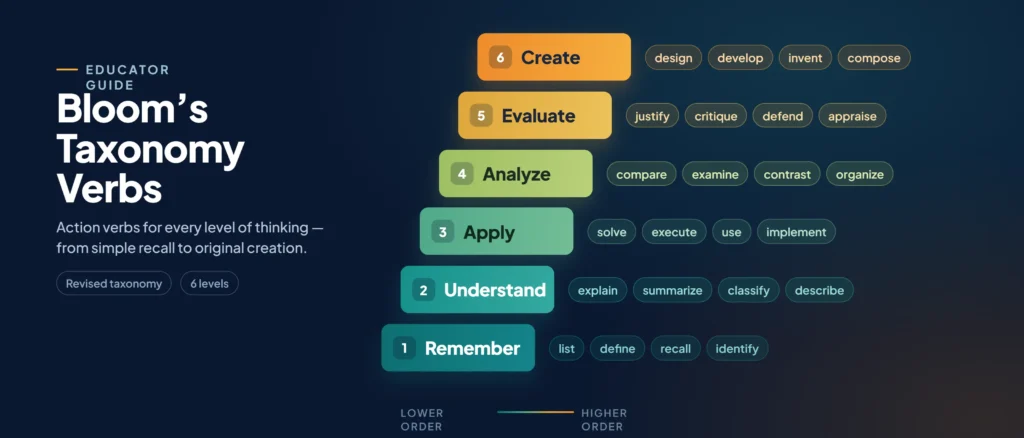
- The 2001 revision has six levels — Remember, Understand, Apply, Analyze, Evaluate, Create — and each carries its own bank of verbs.
- Reach for higher-order verbs (Analyze, Evaluate, Create) when you want genuine thinking rather than recall, and write your questions at that same level.
- Because clean objectives sit under every good course, instructional designers and assessment writers treat these verbs as everyday tools.
Who should read this: teachers, instructional designers, curriculum writers, corporate trainers, and content teams who want a ready-to-use bank of action verbs and objective examples for every cognitive level.
What are Bloom’s taxonomy verbs?
Bloom’s taxonomy verbs are action words mapped to each level of the framework that spell out exactly what a learner can do once instruction ends. Rather than aim at something hazy like “students will understand photosynthesis,” you choose a verb that makes the result visible — “students will diagram the stages of photosynthesis” — so both you and the learner know when the target has been hit.
The whole point is measurability. “Understand” lives quietly inside a learner’s head, but “diagram,” “explain,” and “compare” show up on the page where you can actually assess them. That is why the verb sits at the centre of course design: it locks together the three things that must always agree — the objective, the learning activity, and the assessment. Keep all three at the same cognitive level and the course holds together; let them drift apart and your results stop telling you anything useful.
Benjamin Bloom’s team published the original framework in 1956, and Lorin Anderson and David Krathwohl revised it in 2001, turning the categories from nouns into actions. That revised, verb-based model is the one most teams use today, and every list in this guide follows it. Whether you are drafting a single lesson or mapping a full curriculum, picking the right Bloom’s taxonomy verbs is the quickest way to lift the quality of your learning objectives.
Original vs revised framework
Both versions are worth knowing, because plenty of older textbooks still use the 1956 wording. The original model named its levels with nouns; the 2001 revision rewrote them as verbs and flipped the top two, so that creating — not evaluating — now sits at the summit.
| Original (1956) | Revised (2001) |
|---|---|
| Knowledge | Remember |
| Comprehension | Understand |
| Application | Apply |
| Analysis | Analyze |
| Synthesis | Evaluate |
| Evaluation | Create |
The six Bloom’s taxonomy levels
- Remember: retrieve facts, terms, and basic concepts straight from memory.
- Understand: put an idea into your own words and explain what it means.
- Apply: take what you know and use it in a new, unrehearsed situation.
- Analyze: pull an idea apart and see how the pieces fit and connect.
- Evaluate: weigh something against clear criteria and defend the judgment.
- Create: combine parts into something new, coherent, and original.
The first three levels are lower-order skills and the last three are higher-order skills. Strong courses refuse to park learners at the bottom of the ladder; they plan the climb on purpose, moving from recall toward analysis and creation. Mapping your content against all six Bloom’s taxonomy levels is a core move in curriculum development and instructional design.
The complete verb list by level (150+ verbs)
This is the reference most readers arrive for: a clean, copy-ready bank of Bloom’s taxonomy verbs for every level, ready to open any learning objective you write. This edition lists 154 verbs in all — more than any comparable guide — with a running count for each level so you can see the range at a glance.
| Level | What the learner does | Action verbs |
|---|---|---|
| 1. Remember26 verbs | Recalls facts and terms | define, list, name, recall, identify, label, recognize, state, match, memorize, repeat, select, cite, choose, count, draw, find, locate, quote, read, record, relate, reproduce, retrieve, tell, write |
| 2. Understand26 verbs | Explains meaning in own words | explain, summarize, describe, interpret, classify, compare, discuss, paraphrase, illustrate, restate, infer, translate, convert, estimate, generalize, exemplify, outline, predict, report, review, rewrite, express, extend, map, associate, indicate |
| 3. Apply26 verbs | Uses knowledge in new contexts | apply, use, solve, demonstrate, calculate, implement, execute, operate, complete, modify, sketch, show, administer, build, chart, compute, employ, experiment, dramatize, practice, prepare, schedule, adapt, manipulate, connect, model |
| 4. Analyze26 verbs | Breaks ideas into parts | analyze, differentiate, organize, contrast, examine, categorize, distinguish, deconstruct, investigate, correlate, test, attribute, diagram, dissect, divide, subdivide, discriminate, inspect, question, sequence, structure, isolate, survey, characterize, simplify, trace |
| 5. Evaluate25 verbs | Judges against criteria | evaluate, judge, critique, justify, defend, argue, assess, appraise, recommend, prioritize, rate, support, conclude, decide, determine, grade, measure, rank, score, validate, verify, weigh, criticize, value, reflect |
| 6. Create25 verbs | Produces original work | create, design, develop, compose, construct, formulate, generate, produce, invent, plan, propose, devise, assemble, collect, combine, compile, craft, hypothesize, integrate, originate, reconstruct, revise, synthesize, theorize, forecast |
Total: 154 action verbs across six levels.
Two working notes. First, a word like compare can sit at more than one level depending on the task — the depth of the thinking decides the level, not the verb by itself. Second, keep a short go-to list for each level within reach; deliberately reaching for higher-order Bloom’s verbs is exactly what turns a memorization quiz into real skill building. Teams that produce content at scale, such as our eLearning content development writers, draw from a single standardized verb bank so quality stays even across hundreds of modules.
How to write measurable learning objectives
Every dependable objective follows one simple formula, built around a single Bloom’s verb:
Audience + Behaviour (action verb) + Condition + Degree
For instance: “By the end of the lesson (condition), students (audience) will classify (action verb) at least 8 of 10 rock samples (degree) as igneous, sedimentary, or metamorphic.” Everything but the verb sets the scene; the verb names the behaviour you will actually measure.
So choose the verb first, and choose it to match the cognitive level you truly want — not the one that is easiest to test. Then build the activity and the assessment around that same verb. This is precisely why our assessment authoring and custom eLearning development teams rewrite every objective with a precise action verb before a single slide or question is drafted.
Verbs to avoid in learning objectives
Some words feel like objectives but cannot be observed, which makes them impossible to assess. Keep these out of your outcome statements:
- Understand: there is no way to see “understanding” directly.
- Know: invisible and untestable as written.
- Learn: it names the process, not the result.
- Appreciate: a feeling, not an observable behaviour.
- Be aware of: commits the learner to no measurable action.
- Grasp or comprehend: the same trouble as “understand.”
Swap each one for a concrete Bloom’s verb and the objective snaps into focus. “Understand the water cycle” becomes “diagram the water cycle.” “Know the safety rules” becomes “list the five safety rules.” One word changes an unmeasurable wish into something you can grade.
Bloom’s taxonomy questions by level
Bloom’s taxonomy questions are prompts written to test thinking at one specific level. Match the stem to the level you are targeting:
- Remember: “List the three branches of government.”
- Understand: “Explain, in your own words, why water evaporates.”
- Apply: “Solve this equation using the method just shown.”
- Analyze: “Compare the two authors’ arguments and show where they diverge.”
- Evaluate: “Judge which solution is strongest, and justify your choice.”
- Create: “Design an experiment that could test this hypothesis.”
Writing questions at the higher levels is how you assess deep learning instead of recall, and a well-built test mixes levels on purpose. Getting that balance right is exactly what the psychometric reviewers behind our assessment development work do for every item bank.
A worked example: one topic, six levels
The fastest way to feel how the verbs stack up is to hold the topic still and climb the levels. Here is a single subject — the water cycle — written as one objective per level, each with a matching verb:
- Remember: List the four stages of the water cycle.
- Understand: Explain how evaporation turns liquid water into vapour.
- Apply: Use a labelled diagram to predict where condensation will form.
- Analyze: Contrast how the water cycle behaves in a rainforest versus a desert.
- Evaluate: Judge which human activities disrupt the cycle most, and why.
- Create: Design a poster that teaches the water cycle to younger students.
The subject never changes, yet the thinking deepens with every rung. That is the practical power of Bloom’s verbs: the very same content can be taught and tested at wildly different depths, simply by changing the verb you build the objective around.
Common mistakes to avoid
- Objective–test mismatch: writing an “analyze” objective and then testing it with a recall question. The two must live at the same level.
- Living at the bottom: leaning only on Remember and Understand verbs, so learners never get to practise higher-order thinking.
- Stacking verbs: packing two action words into one objective, which makes it impossible to grade cleanly. One verb per objective.
- Treating verbs as fixed: assuming a word always belongs to a single level. Context decides — judge by the depth of the task, not the word.
Using these verbs across grades and training
- K-12: teachers scaffold from lower to higher levels across a unit, supported by standards-aligned K-12 curriculum.
- Higher education: professors lean on higher-order verbs to drive real analysis through university courseware.
- Corporate training: L&D teams write performance-based objectives inside corporate learning and skill development programs.
- Test prep: item writers tag every question to a level so exams stay accurate and balanced.
- Scenario design: higher-order verbs power the branching decisions in scenario-based learning.
You can see this play out across real programs in our case studies, or learn more about the team behind them at Graveiens.
Frequently asked questions
Q. What are Bloom’s taxonomy verbs?
A. They are action words tied to each level of the framework that state exactly what a learner should be able to do — list, explain, apply, analyze, evaluate, or create — which is what makes a learning objective specific and measurable.
Q. What are the six Bloom’s taxonomy levels?
A. In the 2001 revision they are Remember, Understand, Apply, Analyze, Evaluate, and Create, running from lower-order thinking (recall) up to higher-order thinking (producing original work).
Q. Why use Bloom’s verbs in learning objectives?
A. Because they make outcomes observable and testable. You cannot measure “understand,” but you can measure “diagram” or “compare,” and precise verbs keep your objective, activity, and assessment aligned.
Q. Is “understand” a Bloom’s taxonomy verb?
A. No — “understand” is the name of a level, not a measurable action. Replace it with a concrete verb such as explain, summarize, or interpret so the objective can actually be assessed.
Q. What are examples of higher-order Bloom’s verbs?
A. They come from the top three levels: analyze, differentiate, and examine (Analyze); evaluate, critique, and justify (Evaluate); and create, design, and develop (Create).
Q. How do I write Bloom’s taxonomy questions?
A. Match the question to the objective’s level: use recall stems like “list” or “define” for Remember, and higher-order stems like “compare,” “justify,” or “design” for the deeper levels.
Q. How many verbs should one objective have?
A. Exactly one. Stacking two verbs makes the outcome impossible to grade cleanly, so split it into two separate objectives instead.
Conclusion
Bloom’s taxonomy verbs are the simplest, highest-leverage tool in course design. Replace a vague aim with a precise verb from the right level and you turn “understand” into something you can teach, observe, and measure. Keep the verb list by level within reach, write one action verb per objective, and align your Bloom’s taxonomy questions to the same level — do that consistently and your courses will get measurably, visibly better.
| Need rigorous, measurable courses?From instructional design to assessment authoring, Graveiens EduServices builds objectives and questions around Bloom’s taxonomy from day one — plus a free sample module built to your brief. graveiens.com |
Sources
Anderson, L. W., & Krathwohl, D. R. (2001), A Taxonomy for Learning, Teaching, and Assessing; Vanderbilt University Center for Teaching; University of Arkansas TIPS.

 Academics
UPSC Preparation: A 2026 Strategy Guide From Beginner to the Final Interview
UPSC preparation is the structured, multi-year process of building the knowledge base, answer-writing skill, and temperament needed to clear the…
 Academics
Is NEET Harder than MCAT: What Do the Experts Say?
Choosing the right medical entrance exam can be daunting for students aspiring to become doctors. Among the plethora of options…
 Academics
7 Best Explainer Video Ideas for EdTech Organisations
In the age of educational content being available at the fingertips on multiple platforms, learners have tons of options to…
Get monthly EdTech insights
Trends, content tips and how-tos — once a month, no spam.