TL;DR Key takeaways
- eLearning consulting services help organizations plan, design, and build digital learning that changes performance from strategy and instructional design to full course production, LMS integration, and analytics.
- They differ from a pure production shop: consulting starts with your business goals and learner data, then recommends what to build so you don’t pay to produce the wrong training.
- The most common deliverable is custom eLearning development courses built around your content, brand and KPIs rather than generic off-the-shelf libraries.
- The global eLearning market is worth roughly $390–417 billion in 2026, with the corporate segment growing faster at about 18–22% a year.
- Choosing the right partner comes down to strategy depth, quality assurance, accessibility, and proof of measurable outcomes.
Who this article is for: L&D leaders, publishers, universities and EdTech teams evaluating a learning partner and anyone weighing custom course development against off-the-shelf content.
What are eLearning consulting services?
E-learning consulting services are advisory and delivery services that help organizations design, build, and improve digital learning programs. A good consultant starts by understanding your business outcomes faster onboarding, fewer compliance incidents, higher completion then maps the strategy, content, technology and measurement needed to reach them.
In practice, this work spans the full lifecycle: learning-needs analysis, curriculum and instructional design, content and media production, LMS integration, accessibility compliance, localization and post-launch analytics. That advisory layer is what separates a pile of slides from a program that moves real numbers.
The stakes are high because spending is enormous. The global eLearning market is valued at roughly $390–417 billion in 2026, and the corporate segment is expanding even faster around 18–22% per year. With that much budget in motion, expert eLearning consulting services are how organizations avoid producing training nobody finishes.
e-learning consulting vs custom development
| eLearning consulting | Custom eLearning development | |
|---|---|---|
| Core question | What should we build, and why? | How do we build it well? |
| Typical output | Strategy, curriculum map, roadmap | Finished courses, assessments, media |
| When you need it | Before committing budget | Once the plan is approved |
| Risk it removes | Building the wrong thing | Building the right thing badly |
The strongest partners do both. Consulting sets the direction; execution delivers it. When one team owns strategy through delivery, you avoid the classic failure where a beautiful course teaches the wrong objective — which is why leading providers keep strategists, designers and developers under one roof, moving from a learning solutions blueprint into production without a hand-off gap.
What custom eLearning development includes
Custom eLearning development is the creation of digital courses built specifically around your content, brand, learners and goals as opposed to licensing a generic catalog. A full engagement usually spans:
- Instructional design structured, outcome-driven learning via models like ADDIE and SAM.
- Content & courseware: the actual eLearning content development and writing, aligned to objectives.
- Assessments, item banks, and knowledge checks via expert assessment authoring.
- Media 2D and 3D animation and video that makes concepts stick.
- Interactivity, scenario-based learning, gamification, and simulations.
- Standards & delivery of SCORM- and xAPI-compliant packaging for any LMS.
A modern build also means meeting learners where they are: mobile learning, bite-sized microlearning, and immersive AR/VR learning. Done well, a custom build produces an asset you fully own and can update as your organization changes.
How much do eLearning consulting services cost?
| Interactivity level | Description | Typical cost / finished hour |
|---|---|---|
| Level 1 | Basic page-turner, limited interaction | ~$5,000–$15,000 |
| Level 2 | Interactive, branching, richer media | ~$15,000–$30,000 |
| Level 3 | Simulations, advanced interactions | $30,000+ |
Timelines follow similar logic. A standard one-hour interactive module takes 4–8 weeks end to end; large programs run 3–6 months with parallel teams. Rapid eLearning workflows can compress simpler modules to 2–3 weeks.
A note most buyers miss: research suggests employers underestimate true training spend by 40–60% because indirect costs — SME time, reviews, rework, delayed launches — are never modeled. This is why experienced consultants scope fixed-price after a discovery call, so the number you approve is the number you pay.
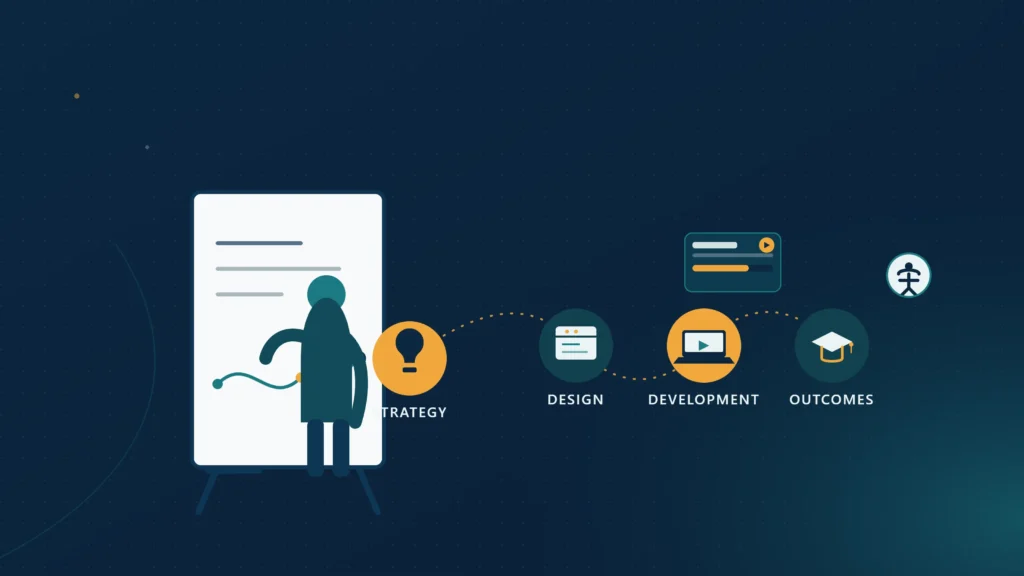
The consulting process: from goals to launch
- Discover. Analyze requirements, audience, and objectives.
- Plan: build the strategic blueprint and map the curriculum.
- Design: create instructional design, UI/UX, and storyboards.
- Develop and produce content, media, and interactions in expert pods.
- Review: run multi-stage QA against global and accessibility standards.
- Deliver, deploy, integrate with your LMS, and launch.
- Support analytics, maintenance, and continuous improvement.
Most engagements move from kickoff to first review in 2–4 weeks. Baking accessibility in from step three to WCAG 2.2 AA rather than bolting it on later prevents expensive rework right before launch.
Build vs buy: when custom eLearning wins
Off-the-shelf libraries are cheap per seat and fine for generic topics. But for a standard-skills subject, a content library usually wins below roughly 150–160 learners over a three-year shelf life; above that or whenever the material is unique to your organization a custom build wins on both cost and impact. Custom is almost always right when:
- The subject is proprietary to your products, processes, or compliance rules.
- You need brand consistency and full IP ownership of the finished asset.
- Completion and retention tie to a business metric.
- You are training at scale, where per-seat licensing balloons.
This decision is where independent advice pays for itself an honest partner tells you when not to build. For enterprises, that often points toward corporate eLearning solutions and skill development programs built around real workplace decisions.
How to measure success
Because the point of training is behavior change, measurement should go beyond completion rates typically along the Kirkpatrick ladder:
- Did the reaction of learners find it relevant and usable?
- Did learning assessment scores actually improve?
- Are people doing the job differently?
- Results: Did the business metric move?
Because xAPI tracks granular learner actions, modern digital learning programs can connect course activity to outcomes. Graveiens clients have seen completion jump from 61% to 96% after compliance training was rebuilt around realistic scenarios, and a localized library lift non-English completion by 58% more in the Graveiens case studies.
Common eLearning mistakes to avoid
- Starting with content, not outcomes. Define the business metric first.
- Confusing information with learning. A policy PDF is not a course; practice and feedback are.
- Treating accessibility as an afterthought. Retrofitting WCAG late is far more expensive.
- Ignoring the LMS reality. Insist on SCORM/xAPI testing before delivery.
- No maintenance plan. Budget for updates so your asset does not go stale.
How to choose an eLearning consulting partner
- Strategy depth: Do they start with your outcomes or jump to production?
- Proven scale case studies with real numbers and named outcomes.
- Quality assurance: a documented multi-stage QA process, not an ad hoc review.
- Accessibility credentials WCAG 2.2 AA, Section 508 and VPAT as standard.
- Subject-matter depth SMEs across your domains, from K-12 to corporate.
- Ownership terms: full IP transfer and editable source files on completion.
A partner that also offers localization in 40+ languages and end-to-end corporate learning under one roof removes coordination overhead. To gauge rigor, read about the Graveiens team’s 1M+ learning assets across 30+ countries at 99% client retention.
Industries served
- Publishing courseware, digitization, and accessibility for publishers.
- K-12 standards-aligned K-12 curriculum and assessments.
- Higher education courseware and instructional design for universities.
- Corporate & L&D compliance, onboarding, and leadership academies at scale.
- EdTech & coaching content, video, and test-prep material that scales.
Frequently asked questions
What do eLearning consulting services include?
eLearning-needs analysis, learning strategy, instructional design, custom course and assessment development, media production, LMS integration, accessibility compliance, localization and post-launch analytics the full lifecycle from goals to measurable outcomes.
What is the difference between eLearning consulting and custom eLearning development?
Consulting decides what to build and why, producing a strategy and roadmap. The development stage is the execution of building the actual courses, assessments, and media. The best partners deliver both.
How much does custom eLearning development cost in 2026?
Typically per finished hour: roughly $5,000–$15,000 for basic modules, $15,000–$30,000 for interactive branching courses, and $30,000+ for simulations. Most vendors confirm fixed pricing after a scoping call.
How long does a custom course take to build?
A standard one-hour interactive module takes about 4–8 weeks end to end. Larger programs run 3–6 months with parallel teams; rapid-authoring can deliver simpler modules in 2–3 weeks.
When should we build custom instead of buying off-the-shelf?
Build custom when the content is unique to your organization, when brand and IP ownership matter, or when training at scale — generally above ~150 learners for a standard topic over three years.
Conclusion
eLearning consulting services exist to make sure your training budget produces learning that performs, not slides people click through and forget. The best engagements begin with strategy, flow into disciplined custom development, and end with measurable outcomes you can prove to leadership.
| Ready to build learning that performs? Book a free consultation with Graveiens EduServices we’ll map the fastest route from your goals to launch and build a free sample module before you commit. graveiens.com |
Sources: Grand View Research e-learning market; Demandsage eLearning statistics 2026; Fact.MR corporate e-learning market; AllenComm custom eLearning cost 2026; BlueCarrot eLearning development cost per hour.

 Uncategorized
eLearning Localization Services: A Practical Guide to Scope, Cost and Choosing a Partner in India
eLearning localization services adapt a digital course’s text, audio, video, visuals, interactions and assessments to a new language and culture,…
 Uncategorized
Differentiated Instruction: Meaning, Strategies, Examples and What the Research Says
Differentiated instruction is a teaching approach in which the teacher keeps one learning goal for every student but adjusts the…
 Uncategorized
CBSE Sample Papers: How to Use Them to Actually Raise Your Board Exam Score
CBSE sample papers are the official practice question papers that the Central Board of Secondary Education publishes each year, together…
Get monthly EdTech insights
Trends, content tips and how-tos — once a month, no spam.