TL;DR: Key takeaways
| Topic | Key fact |
|---|---|
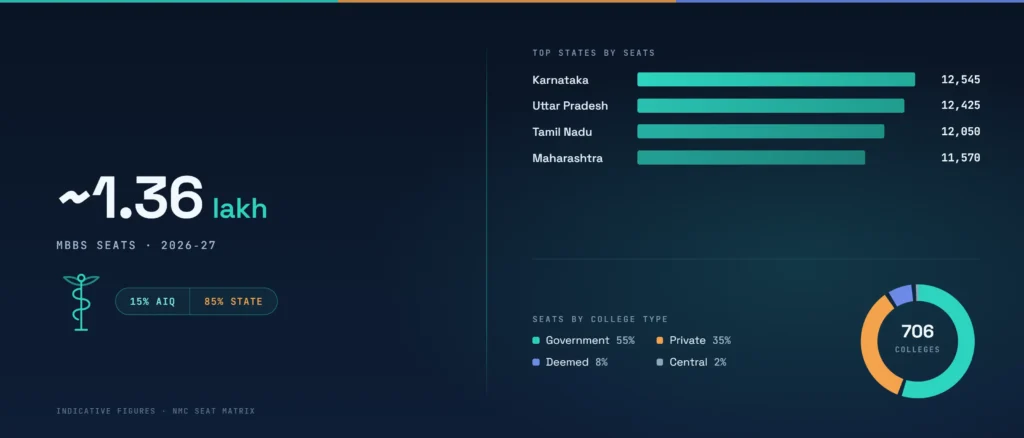
| Total MBBS seats | India has more than 1.2 lakh MBBS seats, reaching about 1.36 lakh for 2026-27 after the NMC approved roughly 9,900 new seats. |
| Seat matrix | Government about 56,000, private about 55,000, deemed about 12,000, and central institutes including AIIMS about 2,900. |
| Top states | Karnataka, Uttar Pradesh, Tamil Nadu and Maharashtra each offer more than 12,000 MBBS seats. |
| How seats are filled | Almost every MBBS seat is filled through NEET UG, split into 15% All India Quota and 85% State Quota. |
| Verify before you rely | Exact seat counts change through the year, so always confirm against the official MCC and NMC seat matrix. |
Who this article is for:
- NEET aspirants and parents who want the current MBBS seat count, the seat matrix, and state-wise numbers.
- Counsellors and coaching teams who need an accurate, up-to-date view of seat availability and cut offs.
- Anyone planning counselling who wants to understand government vs private seats, AIQ vs State Quota, and how seats are allotted.
How many MBBS seats are there in India in 2026-27?
India has more than 1.2 lakh MBBS seats across government, private, deemed, and central institutions, and the total has reached roughly 1.36 lakh for the 2026-27 session after the National Medical Commission (NMC) approved close to 9,900 new seats. The exact number keeps changing through the year as the NMC clears new colleges and seat increases, so treat any single figure as the latest snapshot rather than a fixed value.
For the current cycle, the widely reported total is about 1,36,900, up from roughly 1.18 lakh a year earlier. This is one of the largest expansions of undergraduate medical intake in the country history, in line with the government goal of adding tens of thousands of medical seats over five years.
Because these numbers move, the safest practice is to confirm the current count against the official Medical Counselling Committee and NMC seat matrix before you finalise any college list.
MBBS seat matrix 2026-27
The MBBS seat matrix shows how the total is split across the four college types. Each type carries very different fees, cut offs, and counselling routes.
| College type | Approx. seats | Fees | Competition | Counselling |
|---|---|---|---|---|
| Government | ~56,000 | Low | Very high | AIQ 15% + State 85% |
| Private | ~55,000 | High | Variable | State & institution |
| Deemed | ~12,000 | High | Variable | MCC (all-India) |
| AIIMS/central | ~2,900 | Low | Very high | MCC (100% AIQ) |
Government colleges hold roughly the same share as private ones, but because their fees are far lower, their cut offs run much higher. Note that these totals shift with every NMC approval, so verify the current MBBS seat matrix against the official sources before publishing or advising.
State-wise MBBS seats in India
Seat availability is very uneven across the country. A handful of states dominate the state-wise MBBS seats table, while smaller states have only a few hundred seats. The figures below reflect the latest available 2025-26 compilation and should be confirmed against the official state and MCC seat matrix before you rely on them.
| State | Approx. total MBBS seats |
|---|---|
| Karnataka | ~13,900 |
| Uttar Pradesh | ~13,400 |
| Tamil Nadu | ~13,000 |
| Maharashtra | ~12,800 |
| Rajasthan | ~4,480 |
| Telangana | ~4,400 |
| West Bengal | ~4,350 |
| Gujarat | ~4,250 |
Four states, Karnataka, Uttar Pradesh, Tamil Nadu, and Maharashtra, each offer more than 12,000 seats and together account for a large share of all seats nationwide. Karnataka leads overall, driven by its very large private sector, while Maharashtra, Uttar Pradesh, and Tamil Nadu lead on government capacity. Because domicile rules govern the 85% State Quota, the state-wise MBBS seats picture directly shapes where a candidate has the best realistic chance.
Government MBBS seats in India
Government MBBS seats are the most sought after because of their low fees, so they close at the highest cut offs. There are roughly 56,000 government MBBS seats across central and state government colleges.
On the government side, Maharashtra leads with about 5,900 seats, followed by Uttar Pradesh at about 5,450 and Tamil Nadu at about 5,200. These seats are filled through two channels: 15% through the central All India Quota and 85% through each state own counselling, usually with a domicile requirement. For most aspirants, a government seat is the primary target, which makes an accurate reading of the government seat matrix essential.
Private MBBS seats in India
Private MBBS seats add roughly 55,000 places, close to the government total, but at much higher fees. They widen access well beyond the limited government pool.
Karnataka has the most private MBBS seats at nearly 11,000, followed by Uttar Pradesh at about 8,300 and Tamil Nadu at about 7,850. Private seats are usually filled through state counselling and institutional or management and NRI quotas, each with its own fee structure. For candidates who clear NEET but fall short of the government cut off, private colleges and deemed universities are the realistic route, provided the fees are affordable.
AIIMS and central institute MBBS seats
The All India Institutes of Medical Sciences (AIIMS) are the most prestigious government medical colleges. Across roughly 20 functional AIIMS, there are about 2,257 MBBS seats, ranging from 50 seats at newer institutes to 125 or more at established ones such as AIIMS Jodhpur and AIIMS Bhopal.
Admission to every AIIMS is now 100% through NEET UG, followed by centralised MCC counselling under the All India Quota, with no state quota. Cut offs are extremely high, with AIIMS Delhi typically closing near the very top of the rank list. JIPMER and other central institutes follow the same all-India, MCC-led route.
How MBBS seats are allotted
Once a candidate clears the NEET qualifying bar, seats are allotted through counselling in two main channels:
- All India Quota (AIQ): 15% of government seats, filled centrally through MCC counselling, open to students from any state.
- State Quota: 85% of government seats, filled by each state counselling authority, usually with a domicile requirement.
Deemed universities and central institutes like AIIMS are filled entirely through MCC counselling, while private and management or NRI seats run through state and institutional counselling with their own fees. Your rank, your category, and the choices you lock at each counselling round together decide the final seat, which is why a matrix-based counselling strategy matters as much as the exam score.
NEET marks required for MBBS admission
This is where aspirants most often get confused, because there are two different cut offs.
| Cut off type | What it means |
|---|---|
| Qualifying cut off | The minimum NEET percentile just to be eligible for counselling |
| Government MBBS cut off | The closing score or rank needed to actually secure a government seat |
| Private MBBS cut off | Varies by college, category, and counselling round |
| AIQ cut off | The closing rank through the All India Quota |
The qualifying NEET UG cut off is only an eligibility gate. In NEET 2025 the General and EWS qualifying band was roughly the 50th percentile, while OBC, SC, and ST sat at the 40th percentile. Clearing this only lets you enter counselling.
The admission MBBS NEET cut off is very different and far higher. It is the actual closing rank or score at which a seat fills in a specific college and category. A government MBBS NEET cut off for a popular college can run into the 600s out of 720, well above the qualifying line. Both shift every year, which is why up-to-date assessment content and verified counselling data matter so much.
MBBS seats vs NEET applicants
Seat growth only tells half the story. For NEET 2025, about 22.76 lakh candidates registered and roughly 22.7 lakh appeared, against a little over 1.2 lakh MBBS seats. That works out to close to 19 candidates for every MBBS seat, and far more for a government seat. More seats do not automatically mean easier admission, because NEET participation, score distribution, category reservations, and state quotas all change from year to year.
The practical takeaway is that a realistic, matrix-based plan matters more than the headline seat count. A candidate who understands the state-wise MBBS seats, the government and private split, and the relevant cut offs will build a far stronger college list. Structured NEET prep content and counselling tools exist precisely to turn these numbers into an achievable strategy.
NEET eligibility for MBBS
Before any seat is within reach, a candidate must meet the NEET eligibility criteria. The core requirements for NEET UG are:
- Age: at least 17 years old by 31 December of the admission year.
- Qualification: a Class 12 pass with Physics, Chemistry, Biology or Biotechnology, and English.
- Minimum marks: 50% in PCB for General, 40% for reserved categories, 45% for General-PwD.
- Nationality: Indian nationals, NRIs, OCIs, PIOs, and foreign nationals may all apply.
There is no upper age limit under current rules. NEET UG is scored out of 720 marks from 180 questions, and it is the single gateway to almost every MBBS seat. Verify each requirement early against the official NTA NEET information bulletin.
| Note on postgraduate study: after MBBS and internship, doctors sit NEET PG (an 800-mark, 200-question exam) for MD, MS, and diploma seats. That is a separate stage from the undergraduate MBBS admission covered here. |
Frequently asked questions
Q. How many MBBS seats are there in India in 2026-27?
A. India has more than 1.2 lakh MBBS seats, reaching about 1.36 lakh for 2026-27 after the NMC approved roughly 9,900 new seats. The exact figure changes through the year, so confirm it against the official MCC and NMC seat matrix.
Q. How many government MBBS seats are there in India?
A. There are roughly 56,000 government MBBS seats across central and state government colleges. Maharashtra, Uttar Pradesh, and Tamil Nadu have the most.
Q. How many private MBBS seats are there in India?
A. There are roughly 55,000 private MBBS seats, close to the government total but at much higher fees. Karnataka has the most private seats.
Q. Which state has the highest number of MBBS seats?
A. Karnataka has the highest total, followed by Uttar Pradesh, Tamil Nadu, and Maharashtra, each with more than 12,000 seats.
Q. How many MBBS seats are there in AIIMS?
A. About 2,257 MBBS seats across roughly 20 functional AIIMS, filled entirely through NEET UG and MCC counselling under the All India Quota.
Q. How are MBBS seats allotted?
A. Government seats are split into 15% All India Quota (MCC) and 85% State Quota (state counselling, usually with domicile rules). Deemed and central institutes go through MCC, and private seats through state and institutional counselling.
Q. How many students compete for each MBBS seat?
A. In NEET 2025, about 22.76 lakh candidates registered against a little over 1.2 lakh MBBS seats, roughly 19 candidates per seat, and far more for a government seat.
Q. What NEET marks are needed for a government MBBS seat?
A. The qualifying cut off is only an eligibility gate. The actual admission cut off for a popular government college can run into the 600s out of 720, and it varies by state, category, and round.
Conclusion
Understanding MBBS seats in India means reading the full picture: the total of more than 1.2 lakh seats, the seat matrix across government, private, deemed, and central colleges, the state-wise distribution led by Karnataka, Uttar Pradesh, Tamil Nadu, and Maharashtra, and the very different qualifying and admission cut offs. With roughly 19 candidates competing for every seat, a matrix-based counselling plan, not the headline number, is what turns eligibility into an actual admission. Because these figures change with every NMC approval, always verify the current count against the official MCC and NMC seat matrix before finalising a college list.
| Building NEET or medical-admission content?Partner with Graveiens EduServices for exam-accurate NEET prep content, question banks, and higher-education courseware, verified and kept current for your learners. graveiens.com |
Primary sources (verify seat counts and cut offs here before publishing):
- National Medical Commission (NMC): recognised colleges and approved MBBS seats.
- Medical Counselling Committee (MCC): All India Quota seat matrix and counselling.
- NTA NEET: eligibility, marks, and result statistics.

 Uncategorized
eLearning Localization Services: A Practical Guide to Scope, Cost and Choosing a Partner in India
eLearning localization services adapt a digital course’s text, audio, video, visuals, interactions and assessments to a new language and culture,…
 Uncategorized
Differentiated Instruction: Meaning, Strategies, Examples and What the Research Says
Differentiated instruction is a teaching approach in which the teacher keeps one learning goal for every student but adjusts the…
 Uncategorized
CBSE Sample Papers: How to Use Them to Actually Raise Your Board Exam Score
CBSE sample papers are the official practice question papers that the Central Board of Secondary Education publishes each year, together…
Get monthly EdTech insights
Trends, content tips and how-tos — once a month, no spam.