Last updated: October 2026
Key takeaways
- Education outsourcing companies produce learning content, assessments, media and digital files for publishers, EdTech firms, universities and L&D teams, under your brand and standards.
- Most search results about education outsourcing cover admin and back-office work. If you need content, shortlist content specialists, not general BPO firms.
- Score every vendor with the seven-point PARTNER check: pedagogy, accessibility, review workflow, trial, numbers, ethics and IP, and reporting.
- Never sign a long contract off a sales deck. Run a free sample task, then a paid pilot with written acceptance criteria, then scale.
- Price is driven by subject complexity, media depth, review layers, accessibility scope and turnaround, so compare scoped quotes rather than rate cards.
Education outsourcing companies can add a full content team to your program in weeks. Choose the wrong one and you end up rewriting their work in-house. This guide is for publishers, EdTech product teams, universities and corporate L&D leads who are comparing vendors for content, assessments, media or digital conversion.
You will get a clear map of what these companies do, the main vendor types, a seven-point scoring framework, a pilot-first onboarding process, the cost drivers to discuss, and the red flags that should end a conversation early.
Comparing vendors right now? Request a free sample task and judge our work on your own brief.
What do education outsourcing companies do?
Education outsourcing companies are third-party teams that plan, write, design, review and produce learning materials for education organizations. Typical work includes curriculum and courseware, question banks, instructional design, animation, accessibility remediation, localization and EPUB conversion. The client keeps ownership and final approval. The vendor supplies subject experts, production capacity and quality control.
The term covers two very different markets. Many results for “education outsourcing” describe back-office services such as admissions support, payroll, IT help desks or virtual assistants. That is a valid category, but it is not what a publisher or EdTech company needs when a product launch depends on 3,000 accurate practice questions.
This guide focuses on education content outsourcing: the vendors who produce what learners actually see, read, watch and answer. In short, you are hiring for subject accuracy and pedagogy first, and for capacity second.
Who buys education outsourcing services?
- K-12 and higher-education publishers who need overflow authoring, editing and print-to-digital capacity during adoption cycles.
- EdTech companies that need content, item banks and media feeding an app, LMS or adaptive engine. This is often called edtech content outsourcing.
- Universities and online program teams converting courses for online delivery, or remediating course libraries for accessibility.
- Corporate L&D and training providers building compliance, onboarding and skills courses at volume.
- Test-prep and tutoring companies that need exam-accurate questions, worked solutions and video explanations.
Which services can you outsource to an education content partner?
Almost every stage of content production can be outsourced. What matters is matching the service to the right specialist and asking the right question before you sign. The table below lists the services buyers outsource most often, who usually buys them, and the one question that separates capable vendors from the rest.
| Service | Typical buyer | What to ask |
|---|---|---|
| Content development (courseware, textbooks, lessons) | Publishers, EdTech, universities | Who writes each subject, and what are their qualifications? |
| Assessments and question banks | Test-prep, EdTech, assessment publishers | How are items reviewed, tagged and delivered (for example in QTI)? |
| Instructional design | Corporate L&D, universities | Can you show a storyboard and the learning objectives behind it? |
| 2D/3D animation and video | EdTech, K-12 publishers | Who checks scripts for subject accuracy before animation starts? |
| Accessibility remediation | Universities, publishers, government | Do you test manually with screen readers, or only with automated scans? |
| Localization and translation | Global EdTech, corporate L&D | Do subject experts review the target language, not just linguists? |
| EPUB conversion and typesetting | Publishers | Which EPUB version do you produce, and how do you validate files? |
| Tutoring and homework-help support | Tutoring platforms, test-prep | What accuracy checks and response-time targets apply? |
If you plan to outsource curriculum development, ask for a scope-and-sequence sample before any lesson writing begins. A vendor that cannot map outcomes to standards at the planning stage will struggle at the lesson stage.
What types of education outsourcing companies are there?
There are four main types of education outsourcing companies: full-service content partners, specialist studios, freelancer marketplaces and offshore production studios. They differ in breadth, review depth and how much project management you keep in-house. The right type depends on how many services you need and how much coordination your team can absorb.
| Type | Best for | Watch out for |
|---|---|---|
| Full-service content partner | Programs needing writing, assessment, media and digital files from one team | Uneven depth across services; test the weakest one in your pilot |
| Specialist studio | One deep need, such as animation, accessibility or item writing | You coordinate hand-offs between several vendors |
| Freelancer marketplace | Small, one-off tasks with in-house editors to review | No shared QA layer; quality varies by person |
| Offshore production studio | High-volume, well-specified production at scale | Needs tight specs; check subject-expert depth, not just headcount |
Many buyers end up with a hybrid: one full-service partner for core content and one specialist for a niche such as psychometrics. That works well when each vendor’s scope and sign-off point is written into the statement of work.
How to choose an education outsourcing company: the PARTNER check
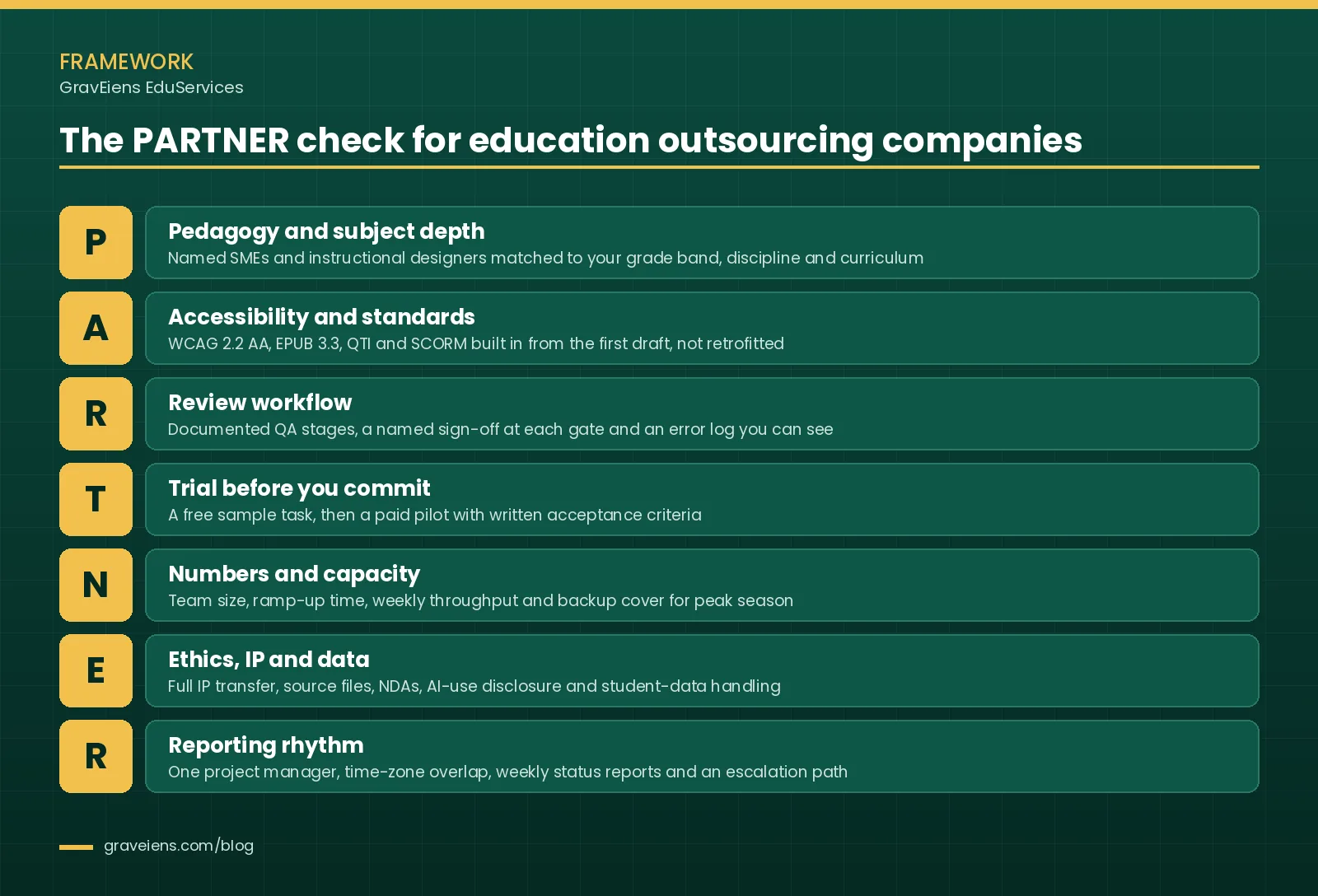
To choose an education outsourcing company, score each shortlisted vendor on seven criteria: pedagogy and subject depth, accessibility and standards, review workflow, a trial before you commit, capacity numbers, ethics and IP terms, and reporting rhythm. Weight the criteria for your project, then let a paid pilot settle close calls.
P: Pedagogy and subject depth
Ask who will actually write your content. You want named roles: subject-matter experts with teaching or industry experience, and instructional designers who turn that expertise into learning. A vendor that staffs every subject from one pool of generalist writers will produce fluent text with shallow accuracy.
A: Accessibility and standards
Accessibility should be built in from the first draft. The benchmark is the W3C’s Web Content Accessibility Guidelines (WCAG) 2.2, a W3C Recommendation since October 2023 and updated in December 2024. For digital books, ask for files that conform to EPUB 3.3, a W3C Recommendation since May 2023. For question banks, ask whether items can be delivered in 1EdTech’s QTI format, now at version 3.0, which packages tests and questions so they move between platforms.
R: Review workflow
Ask the vendor to draw their quality workflow on one page. How many review stages are there? Who signs off at each one? Is there an error log you can see? A credible answer names stages and owners. A weak answer is “our editors check everything.”
T: Trial before you commit
A sample task shows ability. A paid pilot shows process. You need both, so insist on written acceptance criteria before the pilot starts.
N: Numbers and capacity
Ask how many people would be assigned, how fast the team can ramp up, and what weekly output they can sustain. Ask what happens during peak season, or when a key writer leaves mid-project.
E: Ethics, IP and data
Your contract should transfer full intellectual property and editable source files to you. Ask how the vendor uses generative AI, and whether every AI-assisted draft is checked by a human subject expert. If learner data is involved, ask how it is stored, who can access it and where it is processed.
R: Reporting rhythm
You need one accountable project manager, working-hour overlap with your team, a weekly status report and a clear escalation path. In our experience, communication gaps derail as many projects as skill gaps do.
How to score the PARTNER check
- Rate each vendor from 1 to 5 on all seven criteria.
- Give double weight to the two criteria that matter most for this project (for example, accessibility for a university remediation program).
- Drop any vendor that scores 1 on any criterion, whatever its total.
- Take the top two into a sample task, and the winner into a paid pilot.
If you are hiring for course design specifically, our guide on how to choose an instructional design company covers that decision in more depth.
Want to test the PARTNER check on us? Send one chapter or 20 items and get a scoped quote with a free sample.
How does a pilot-first outsourcing process work?
A pilot-first process tests an education outsourcing partner in three rising steps: a small free sample task, a paid pilot that runs through the vendor’s full workflow, and a scale-up only after the pilot meets agreed acceptance criteria. It limits your risk, exposes process gaps early and gives both teams a shared quality bar.
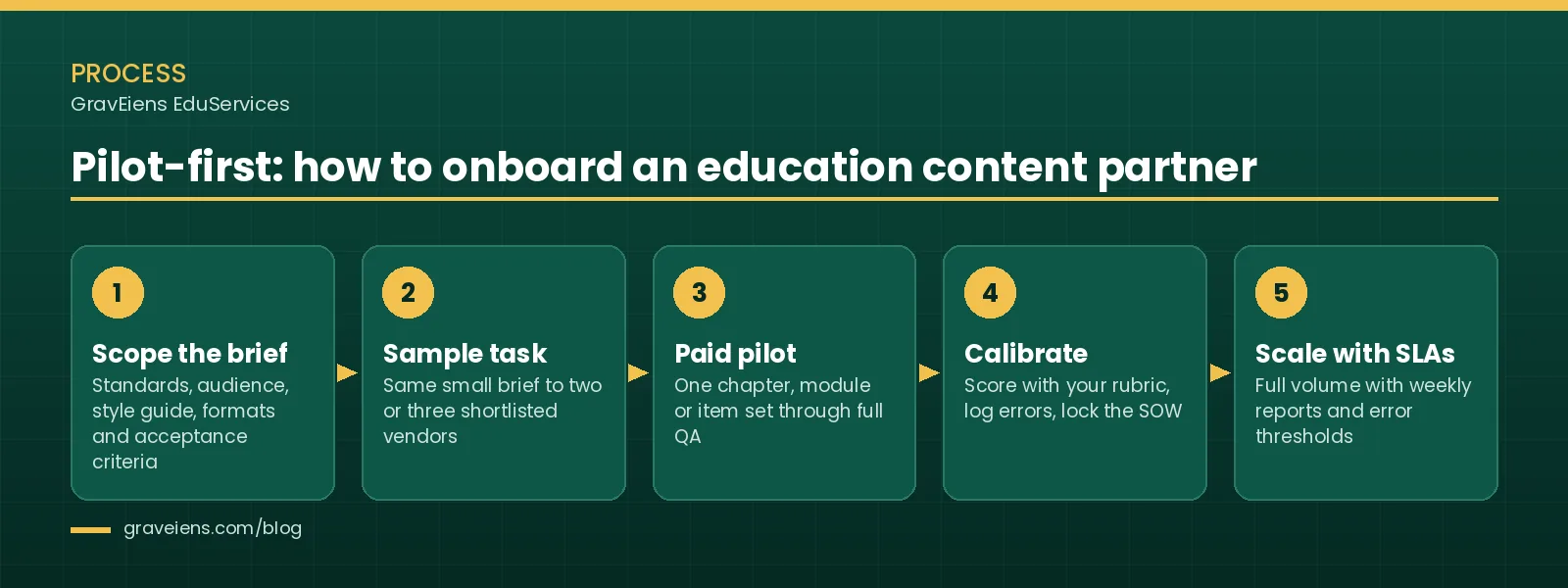
- Scope the brief. Write down the standards, audience, reading level, style guide, file formats and what “accepted” means. This document becomes the base of your statement of work (SOW).
- Run a sample task. Send the same small brief to two or three shortlisted vendors: one lesson, ten to twenty questions, or a few pages for conversion. Compare the results side by side.
- Commission a paid pilot. Give the strongest vendor a real unit of work, such as one chapter, one module or one item set, and ask them to run it through every review stage they promised.
- Review and calibrate. Score the pilot against your rubric. Log every error by type (accuracy, style, accessibility, formatting). Update the style guide where your own brief was unclear.
- Scale with service levels. Move to full volume with agreed turnaround times, error thresholds, weekly reporting and named owners on both sides.
One practical tip: keep the pilot error log. It becomes the training document for every new writer the vendor adds as volume grows.
How much do education outsourcing services cost?
Education outsourcing services are usually priced per unit of output (per page, per item, per finished minute of media or per learning hour), per hour of effort, or as a monthly retainer for a dedicated team. The final cost depends on subject complexity, media depth, review layers, accessibility scope, languages and turnaround, so compare scoped quotes on identical briefs.
We do not publish rate cards here, because two projects with the same page count can differ widely in effort. Instead, use the table below to understand what moves the price, and ask each vendor to explain their quote in these terms.
| Pricing model | Common for | What drives the cost |
|---|---|---|
| Per page | Content writing, editing, EPUB conversion, typesetting | Subject level, art and tables per page, math markup, layout complexity |
| Per item | Question banks and assessments | Item type, solution depth, review layers, metadata tagging |
| Per finished minute | Animation and video | 2D vs 3D, script and storyboard work, voice-over, revisions |
| Per learning hour | eLearning courses | Interactivity level, media mix, assessment depth, authoring tool |
| Hourly | Consulting, instructional design, SME review | Seniority, discovery scope, number of stakeholders |
| Monthly retainer | Dedicated teams for ongoing programs | Team size, skill mix, guaranteed capacity, reporting |
Cost drivers buyers often miss
- Review rounds. Each extra client review round adds time. Agree on the number of rounds in the SOW.
- Accessibility scope. Alt text for complex STEM images, MathML and screen-reader testing take real effort. Building them in costs less than retrofitting later.
- Source quality. Clean, editable source files lower conversion and editing costs. Scanned PDFs raise them.
- Turnaround. Rush timelines need larger teams working in parallel, which adds coordination cost.
- Change requests. A late change to the style guide can ripple through hundreds of finished assets.
Red flags when comparing outsourcing solutions for education
Many failed outsourcing projects show warning signs during the sales stage. Treat any of the following as a reason to slow down or walk away.
- No sample, no pilot. The vendor asks for a long commitment before showing work on your own brief.
- Vague reviewers. They cannot say who reviews your content, or what qualifies those people.
- Accessibility as an add-on. WCAG work is quoted as a separate clean-up phase rather than built into production.
- Unclear IP terms. The contract licenses content back to you, or withholds editable source files.
- Silent AI use. They will not say whether drafts are AI-generated, or how humans verify them.
- Certificates you cannot check. Quality claims without a certificate number or issuing body. Ask for the certificate and confirm the scope and expiry date with the issuer.
- Prices far below every other quote. Often a sign that review layers have been cut, or the scope has been misread.
- Every answer is “yes”. A capable partner will push back on an unrealistic deadline or a weak brief.
On quality certificates: ISO 9001 is the international standard for quality management systems. ISO published its newest edition, ISO 9001:2026, on 16 September 2026, and certified organizations move to it within their certification cycle. Either edition is a good sign, but it certifies a management process, not the quality of a specific lesson. That is why the pilot still matters.
For a shorter primer on getting the basics right before you outsource, see our earlier post on seven tips for successful education outsourcing.
In-house team vs education outsourcing: which is right for you?
Keep work in-house when it depends on deep, daily product knowledge and steady volume. Outsource when you need specialist skills, have peaks in demand, or are adding subjects, languages or formats faster than you can hire. Most mature content programs do both: a small in-house team owns strategy and final approval, and a partner supplies production capacity.
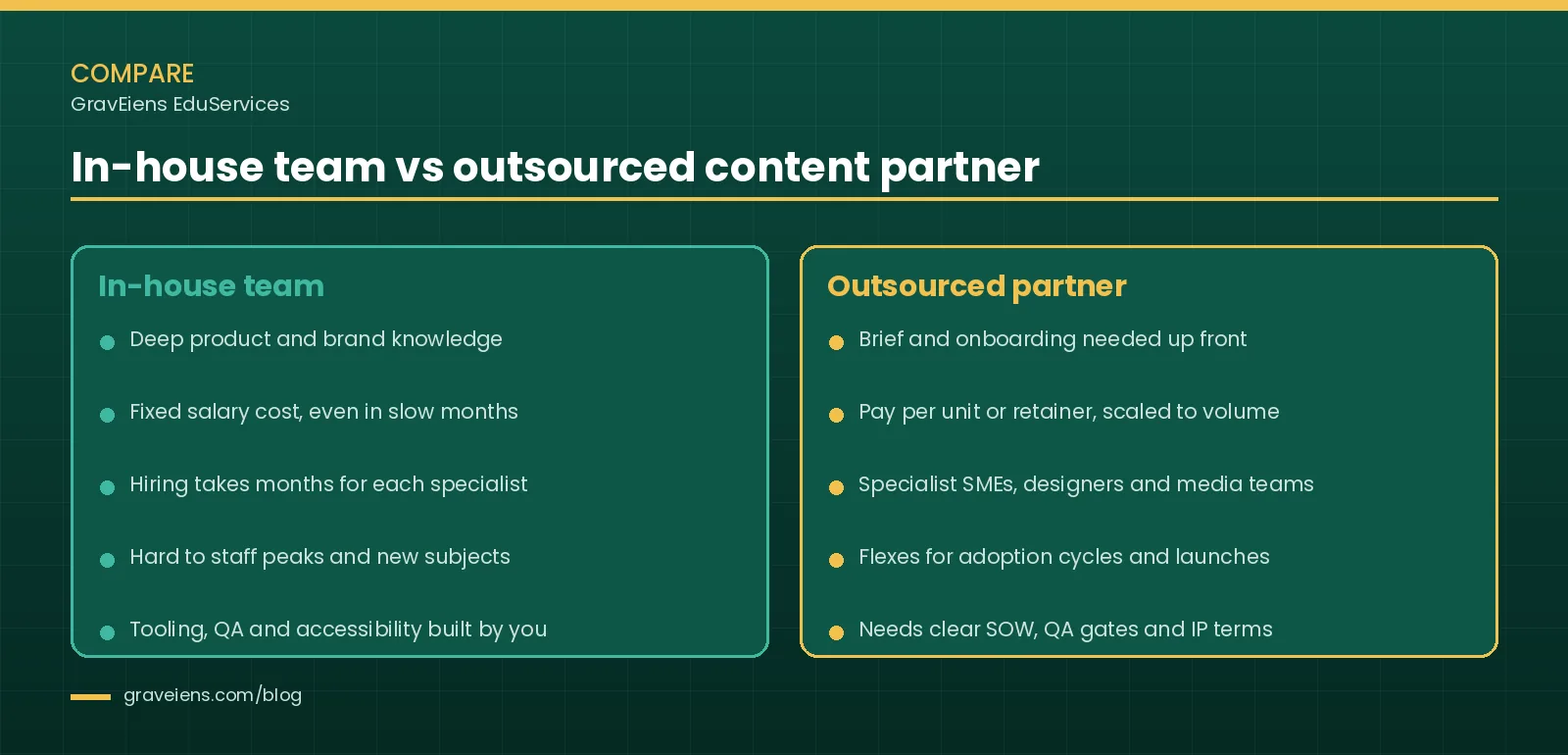
| Factor | In-house team | Outsourced partner |
|---|---|---|
| Cost structure | Fixed salaries and benefits | Variable, tied to scope and volume |
| Speed to start | Slow; each role needs hiring | Fast, after brief and pilot |
| Specialist skills | Limited to who you employ | SMEs, designers, media and accessibility teams |
| Product knowledge | Deep and daily | Built through onboarding and style guides |
| Peak capacity | Hard to flex | Scales up and down with demand |
How GravEiens EduServices works as an education outsourcing partner
GravEiens EduServices is an ISO 9001 certified education content company, founded in 2017. More than 700 experts have delivered over 2 million digital assets for 350+ clients worldwide, including more than 10,000 learning resources. We work as an extension of your team, under your brand, style guide and standards.
Our four-stage QA workflow
- Content creation. Subject experts and instructional designers draft to your brief, standards and style guide.
- Internal review. A separate reviewer checks accuracy, pedagogy, language, accessibility and formatting before anything reaches you.
- Client review. Your team reviews and comments, and we fold the feedback into the style guide so it does not repeat.
- Final delivery. Files are delivered in your required formats, with editable sources.
What we can take on
- eLearning content development, from curriculum mapping and courseware to SCORM-ready courses.
- Assessment authoring and question bank development, with tagging to your blueprint and delivery formats such as QTI.
- Accessibility remediation for courses, documents and digital books, tested against WCAG 2.2 AA.
- Instructional design, 2D/3D animation, localization, EPUB conversion and tutoring support. For anything outside this list, we scope it with you.
Every engagement starts the same way: a free sample task on your brief, then a paid pilot, then scale. You see our work before you commit.
What is education outsourcing?
Education outsourcing means contracting a third-party company to handle work an education organization would otherwise do in-house. It ranges from back-office tasks, such as admissions and IT support, to content work such as curriculum, courseware, question banks, animation, accessibility and localization. For publishers and EdTech firms, the content side matters most, because it shapes what learners actually use.
What are the benefits of working with education outsourcing companies?
The main benefits are access to specialist subject experts, faster ramp-up for launches and adoption cycles, variable rather than fixed costs, and capacity to add subjects, languages or formats without hiring. A good partner also brings tested QA workflows and accessibility expertise that are expensive to build from scratch. The trade-off is time spent on briefs, onboarding and review.
How do I protect my IP and data when outsourcing education content?
Put full IP transfer and delivery of editable source files in the contract. Sign an NDA before sharing unpublished material. Ask how the vendor stores files, who can access them, and whether any learner data is involved. Also ask for a written policy on generative AI use, so you know which tools touch your content and how outputs are verified.
How long does it take to onboard an education outsourcing partner?
It depends on scope, but plan for three stages: a short sample task, a paid pilot on one real unit of work, and a calibration step before full volume. The pilot is usually sized to one chapter, one course module or a small item set. Clear briefs, style guides and acceptance criteria shorten every stage.
Is it cheaper to outsource education content to India?
Offshore teams in India often cost less than equivalent in-house hiring in the US or UK, but the saving only holds if quality holds. Compare vendors on identical briefs, count your own review time, and check subject-expert depth, accessibility skills and time-zone overlap. A cheap quote that needs heavy rework costs more in the end.
Can education outsourcing companies use AI to create content?
Many do use generative AI to speed up research, drafting or variant generation. The question is how outputs are checked. Ask whether every AI-assisted asset is reviewed by a qualified subject expert, how accuracy is verified, and whether the vendor will disclose AI use per deliverable. Human review should be a fixed QA stage, not an optional extra.
What should a statement of work for education content include?
A strong SOW covers scope and volume, standards and reading level, style guide, file formats, accessibility requirements, number of review rounds, acceptance criteria, turnaround times, error thresholds, reporting cadence, IP transfer and change-request pricing. Base it on the brief you used for the pilot, updated with everything the pilot taught both teams.
Request a free sample task
Send us one chapter, one lesson or 20 questions with your style guide. We will return a finished sample through our full review workflow, plus a scoped quote for your program. No commitment, and you keep the sample.
Sources
- International Organization for Standardization, ISO 9001: Quality management systems, Requirements (2026 edition published 16 September 2026).
- W3C, Web Content Accessibility Guidelines (WCAG) 2.2, W3C Recommendation (5 October 2023, updated 12 December 2024).
- W3C, EPUB 3.3, W3C Recommendation (25 May 2023).
- 1EdTech Consortium, Question and Test Interoperability (QTI), version 3.0.
About the author
GravEiens EduServices Editorial Team. Our editorial team is made up of instructional designers, subject-matter experts, assessment specialists and accessibility reviewers who run content, assessment and digital publishing projects for publishers, EdTech companies, universities and L&D teams. GravEiens EduServices has been building learning content since 2017 under an ISO 9001 certified quality system.

 Accessibility
ADA Title II Deadline: What Colleges Must Fix in Digital Course Content (and Where to Start)
ADA Title II deadline: April 26, 2027 for most public colleges. See what course content is in scope, a remediation…
 Assessment & Question Banks
Question Bank Development Services: Process, Quality Checks and Cost Drivers
Question bank development services explained: item anatomy, 7-step process, QA checklist and cost drivers. Send your blueprint for 20 free…
 Uncategorized
Summative Assessment: Meaning, Types, Examples and How It Differs From Formative Assessment
Summative assessment is a graded evaluation given at the end of a unit, term, course or programme to measure what…
Get monthly EdTech insights
Trends, content tips and how-tos — once a month, no spam.