Last updated: November 2026
Key takeaways
- EPUB conversion cost per page reflects the work each page needs, not the page count alone. Source files, layout, math, images and the accessibility target move effort the most.
- Scanned pages, fixed-layout titles and math-heavy pages usually take the most effort per page. Clean InDesign or styled Word files with plain text take the least.
- Accessibility is one cost driver, not a separate project, when it is built in during conversion. EPUB Accessibility 1.1 requires schema.org accessibility metadata in every EPUB.
- Per-page, per-title, per-item and hourly pricing all exist. Compare quotes on what each one includes, such as alt text, MathML, validation and correction rounds.
- The fastest route to an accurate quote is a short spec plus 3 sample pages or one chapter, converted and validated before the full job is priced.
EPUB conversion cost per page is the first number most publishers ask for, and the least useful one on its own. Two 300-page books can need very different amounts of work. One is clean InDesign text. The other is a scanned science textbook full of equations, tables and figures.
This guide is for trade, education and academic publishers, university presses and EdTech teams planning a conversion budget. It explains what drives the per-page price and how pricing models compare. It also shows how to score a title with our PRICE worksheet and what to send for a quote you can trust.
Want a number based on your own files? Send 3 sample pages or one chapter for a free sample conversion and a scoped quote.
What is EPUB conversion cost per page, and why does it vary so much?
EPUB conversion cost per page is the price a vendor charges to rebuild one source page as valid EPUB markup. It varies because pages are not equal. A plain text page needs little more than styling. A page with a table, an equation, two figures and footnotes needs structure, descriptions, coding and testing.
EPUB is not a picture of a printed page. The W3C’s EPUB 3.3 Recommendation describes it as a format that packages HTML, CSS, SVG and other web content into a single file. As of November 2026, the latest published version of EPUB 3.3 is dated 13 January 2026.
So conversion means rebuilding print layout as structured web content. For each page, someone has to decide what is a heading, a list, a caption, a note or a running header to drop. Then the content is coded, linked, described and checked.
A per-page price is an average across all of that work. It only makes sense once you know which pages are easy and which are hard. Ask any vendor what kind of page their rate assumes.
There is also a definition problem. “Page” can mean a printed book page, a page of the source PDF or a manuscript page. A 250-page print book can be a 400-page Word file. Agree on the counting rule before you compare numbers.
In short: the per-page price averages very different pages. Find out which pages the average assumes and how the vendor counts them.
Which pricing model fits your project: per page, per title, per item or hourly?
Per-page pricing suits long titles with consistent design. Per-title pricing suits short or highly designed books where page counts mislead. Per-item pricing covers add-ons such as alt text, MathML or audio sync. Hourly pricing fits open-ended rework. Most real quotes blend a per-page base with priced add-ons.
Ebook conversion pricing usually follows one of these four models. The table shows where each works and where it can surprise you.
| Model | How it works | Best for | Watch out for |
|---|---|---|---|
| Per page | One rate per source page, often tiered as simple, medium or complex | Long, text-led titles and backlists with a shared design | How pages are counted and what makes a page “complex” |
| Per title | One fixed fee for the whole book | Picture books, short titles and design-heavy books | How many correction rounds the fee includes |
| Per item | A unit rate for figures, equations, links, index terms or media files | Image-heavy STEM titles, alt text, MathML and audio sync | Whether decorative images and simple symbols are counted |
| Hourly | Time and materials | Rework, custom interactivity and unclear scope | No ceiling unless you set one in writing |
Tiered rates are the most common way vendors express EPUB conversion cost per page. If a quote uses tiers, ask for the written definition of each tier. Then ask which chapters of your book fall into which tier.
Per-item add-ons are where quotes drift apart. One vendor folds alt text into the page rate. Another prices each figure. Neither is wrong, but you can only compare them side by side once both are written out.
In short: pick the model that matches your content, then make every add-on visible before you compare totals.
How does an EPUB conversion project work, from sample to delivery?
A professional conversion runs in six stages: sample, spec, structure, enrich, validate and deliver. Most of the per-page effort sits in the structure and enrich stages. Validation catches errors and sends them back for rework, so a strong spec and sample keep both the schedule and the budget stable.
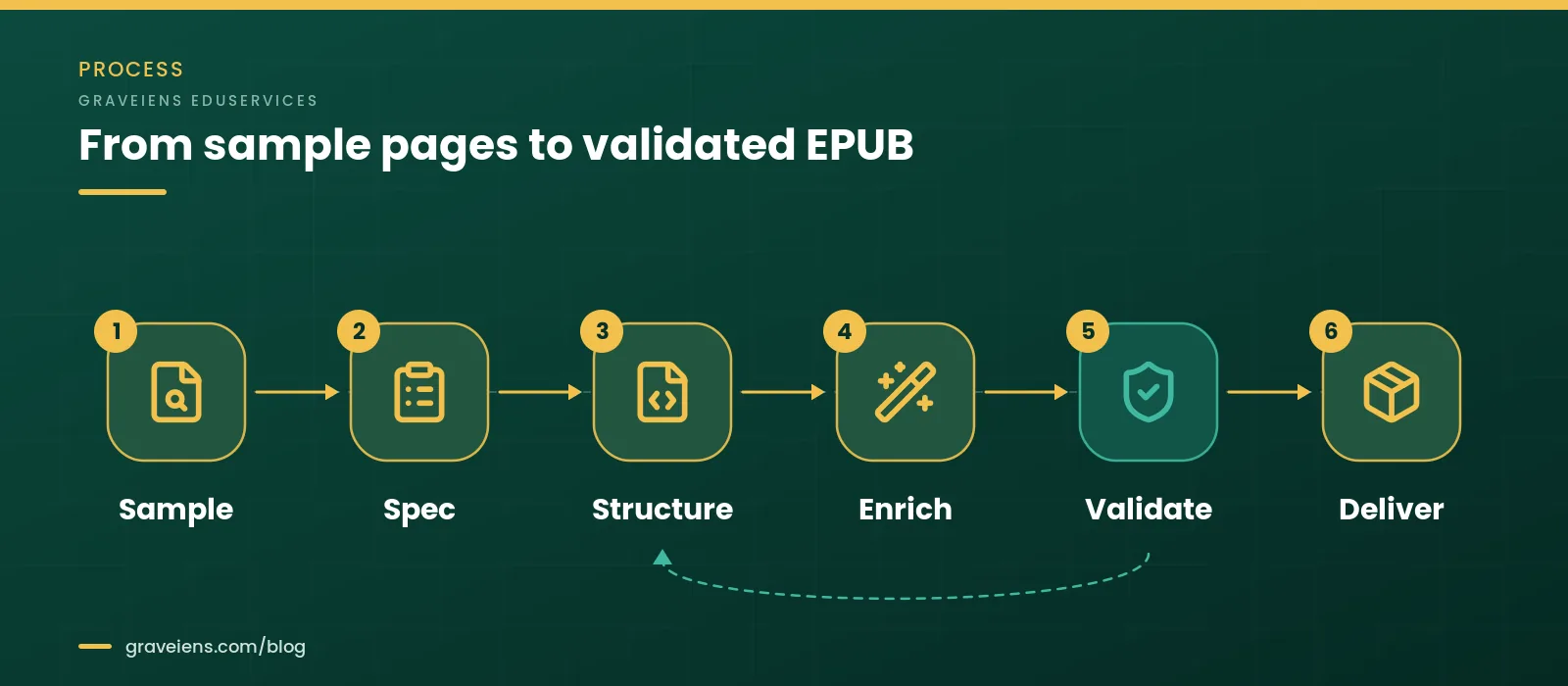
- Sample. The vendor converts 3 pages or one chapter, chosen from your hardest content. Source problems such as missing fonts, flattened tables or image-only pages show up here.
- Spec. You agree the target format, EPUB version, accessibility target, style rules, alt text policy, math approach and deliverables. The spec is what the price is based on.
- Structure. Content is extracted from InDesign, Word, PDF or scans. Scans need optical character recognition (OCR) and human proofreading first. The team then builds semantic HTML, reading order and navigation.
- Enrich. Images are processed and described, equations are coded, and notes, index entries and cross-references are linked. Media overlays or interactive elements are added if the spec calls for them.
- Validate. The file is checked with EPUBCheck and an accessibility checker such as Ace by DAISY. Reviewers then test it in real reading apps and with a screen reader. Errors loop back to the structure stage.
- Deliver. You receive the final EPUB, its metadata and any agreed reports. A correction round follows your review.
Several roles touch each page. A production lead owns the spec. Conversion specialists build the markup. Subject experts write descriptions for complex figures and check math. A separate reviewer runs QA.
That chain explains why a cheap per-page rate can cost more later. If a step is skipped, the gap shows up at validation or after launch, and the page is paid for twice.
In short: effort concentrates in structure and enrichment. A good sample and a locked spec are what make the price predictable.
What drives EPUB conversion cost per page?
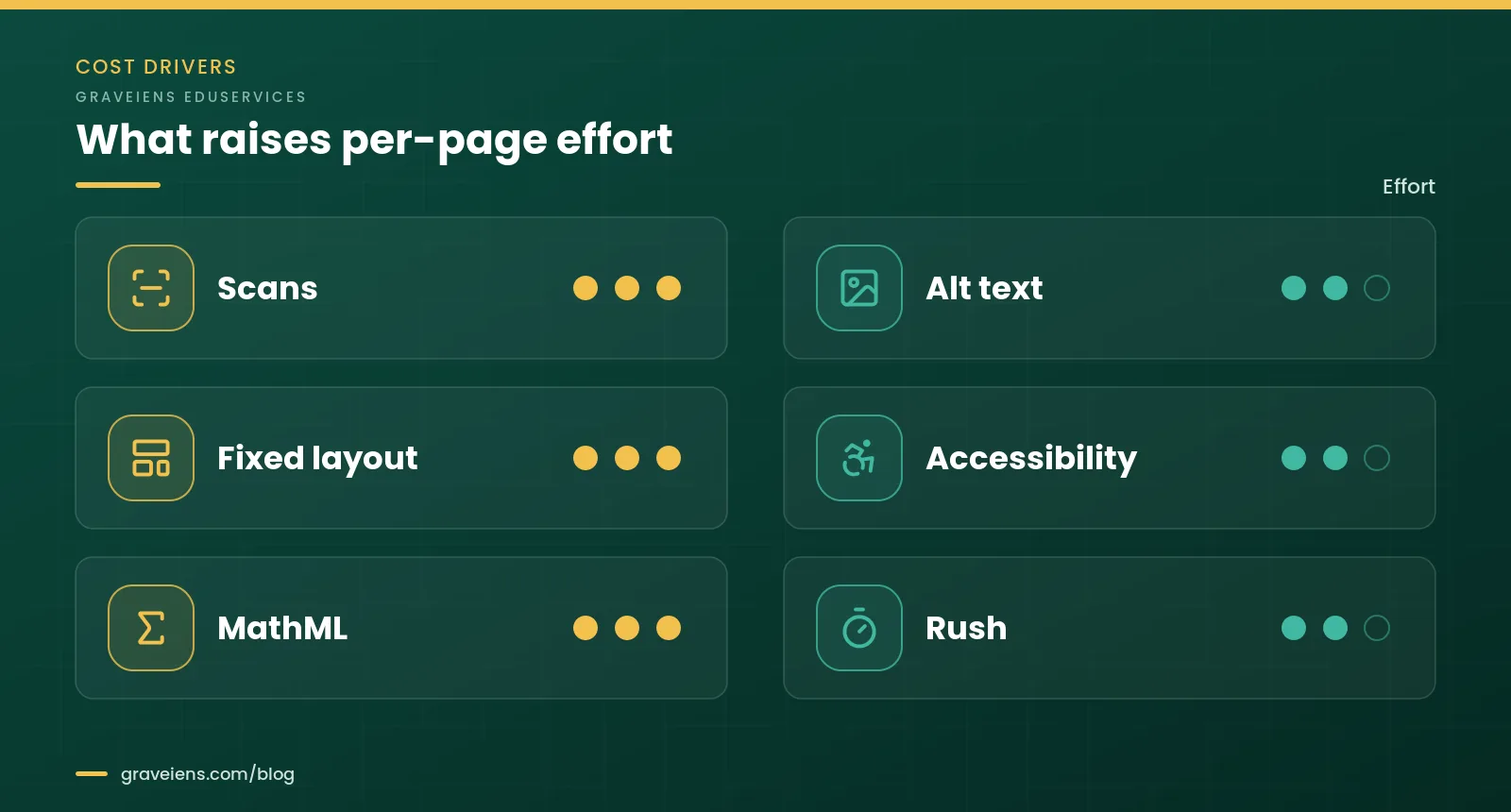
Twelve factors drive EPUB conversion cost per page. The biggest are source file type, layout, math and interactivity. Images and alt text, notes and index linking, accessibility conformance, QA depth, turnaround and language add effort on top. Volume works the other way, because shared setup is spread across many titles.
| Cost driver | Lower effort | Higher effort | Typical impact |
|---|---|---|---|
| Source file type | Clean InDesign or styled Word | Scanned print or image-only PDF | High |
| Layout | Reflowable, single column | Fixed layout or complex multi-column pages | High |
| Tables | Few, simple tables | Many large, nested or page-spanning tables | Medium |
| Math and science notation | None | Equations coded as MathML | High |
| Images and alt text | Few or decorative images | Many complex figures with extended descriptions | Medium (high for STEM) |
| Notes, index and cross-links | Few notes, no index | Linked endnotes, index terms and cross-references | Medium |
| Interactivity and media overlays | None | Read-aloud audio sync, embedded media or scripted activities | High |
| Accessibility conformance and metadata | Accessible structure and required metadata | A documented EPUB Accessibility 1.1 claim at WCAG AA | Medium |
| QA and validation | EPUBCheck only | EPUBCheck, Ace by DAISY, reading-app and screen reader testing | Medium |
| Volume and batching | Many titles sharing one design | One title with a unique design | Lowers cost at scale |
| Turnaround | Flexible schedule | Rush delivery | Medium |
| Language and script | One Latin-script language | Non-Latin, right-to-left or mixed scripts | Medium |
Source file type: InDesign, Word, PDF or scan
Source files set the starting point for every page. A well-built InDesign file with paragraph styles maps cleanly to headings and lists. Styled Word files come next.
A PDF stores where ink sits on a page, not the reading order, so structure has to be rebuilt. That is why PDF to EPUB cost usually runs higher than converting from InDesign. Our guide to converting PDF to EPUB explains the reconstruction work in detail.
Scans cost the most. Each page needs OCR, human proofreading and image cleanup before conversion can start. If you hold InDesign packages for any title, send them instead of the PDF.
Reflowable EPUB vs fixed layout EPUB cost
A reflowable EPUB lets text rewrap to any screen and font size. It suits novels, monographs and most textbooks. Effort scales with structure, not with visual design.
Fixed layout keeps each page exactly as designed. EPUB 3.3 marks fixed-layout documents as “pre-paginated” in the package document. Every page is positioned by hand or by script, so fixed layout EPUB cost per page is usually higher. It also takes extra work to make fixed-layout pages accessible.
Choose fixed layout only when the design carries meaning, as in picture books, comics or some early-reader titles. For school titles that mix both, our K-12 eBook creation team decides the format chapter by chapter.
Tables, math and MathML
Tables need real header cells and a sensible reading order, or screen readers lose the reader. Large or nested tables take time to rebuild and test.
Math is the steepest driver for STEM titles. EPUB 3 supports MathML Presentation Markup, according to EPUB 3.3. Coded equations scale with text and can be read aloud. Equation images are cheaper up front but fail both tests, so many education publishers now specify MathML.
Images and alt text
Every meaningful image needs alternative text. Charts, diagrams and maps often also need an extended description. Effort depends on the share of complex figures, the subject level and who writes the descriptions.
Decide early whether your editors or the vendor will write alt text. For science and math titles, our guide to writing alt text for STEM images shows what good descriptions involve.
Footnotes, endnotes, index and cross-links
Notes must link to and from their references. Index entries must point to the right place in a file that has no fixed pages. Cross-references such as “see Figure 4.2” become working links.
Each link is small, but a scholarly title can contain thousands. Count them before you ask for a quote.
Interactivity and media overlays
EPUB 3.3 defines media overlays, which synchronize recorded audio with the text for read-aloud highlighting. Audio sync, embedded video and scripted quizzes all add build and test time. Price them as separate line items so they do not hide inside the page rate.
Accessibility conformance and metadata
Accessibility is one cost driver here, and it costs least when built in during conversion. The W3C’s EPUB Accessibility 1.1 specification, a Recommendation dated 17 October 2024, sets the rules.
It requires every EPUB to carry schema.org accessibility metadata: accessMode, accessibilityFeature and accessibilityHazard. It recommends accessibilitySummary and accessModeSufficient as well. Its minimum conformance level is WCAG 2.0 Level A, but it strongly recommends the latest WCAG 2 at Level AA.
Market rules raise the stakes. The European Commission lists e-books among the products and services covered by the European Accessibility Act. The Federation of European Publishers notes it has applied to e-books sold in the EU since 28 June 2025, including titles from publishers outside the EU.
There are exceptions, for example for micro-enterprises with fewer than 10 staff and no more than 2 million euros in annual turnover or balance sheet total. Our guide for publishers preparing for the European Accessibility Act covers scope and backlist timing. This article is not legal advice, so confirm your obligations with counsel.
So the accessible EPUB price difference is mostly about the claim you need to make. Building accessible structure costs little extra during conversion. A documented conformance claim, extended descriptions and manual testing add more. Fixing finished files later is a separate job for accessibility remediation.
QA and validation: EPUBCheck and Ace by DAISY
EPUBCheck is the official conformance checker for EPUB. It is a free, open-source W3C project maintained by the DAISY Consortium, and it checks EPUB 2 and EPUB 3 files. As of November 2026, its current release is version 5.4.0.
Ace by DAISY is a free, open-source tool that runs automated accessibility tests on EPUB files. It produces an HTML report on violations, metadata, outlines and images. DAISY describes it as an aid to evaluating conformance, so manual review is still needed for alt text quality and reading order.
Both tools are free, but the people who read the reports and fix the issues are not. A quote that includes reading-app and screen reader testing will cost more per page than one that stops at EPUBCheck. It will also fail less often after launch.
Volume and backlist conversion, turnaround and language
Volume lowers effort per page. Setup work, such as style mapping, CSS templates and conversion scripts, is shared across every title in a series. Backlist conversion in batches of titles with similar design is usually the most efficient way to convert a catalog.
Rush schedules do the opposite. They need more people working in parallel, plus extra coordination and review.
Language and script matter too. Non-Latin scripts, right-to-left page progression and mixed-language titles need font licensing checks and native-speaker proofreading.
In short: source files, layout, math and interactivity set the base effort. Accessibility, QA, turnaround and language add to it, and batching takes it down.
The PRICE worksheet: how to estimate effort before you ask for a quote
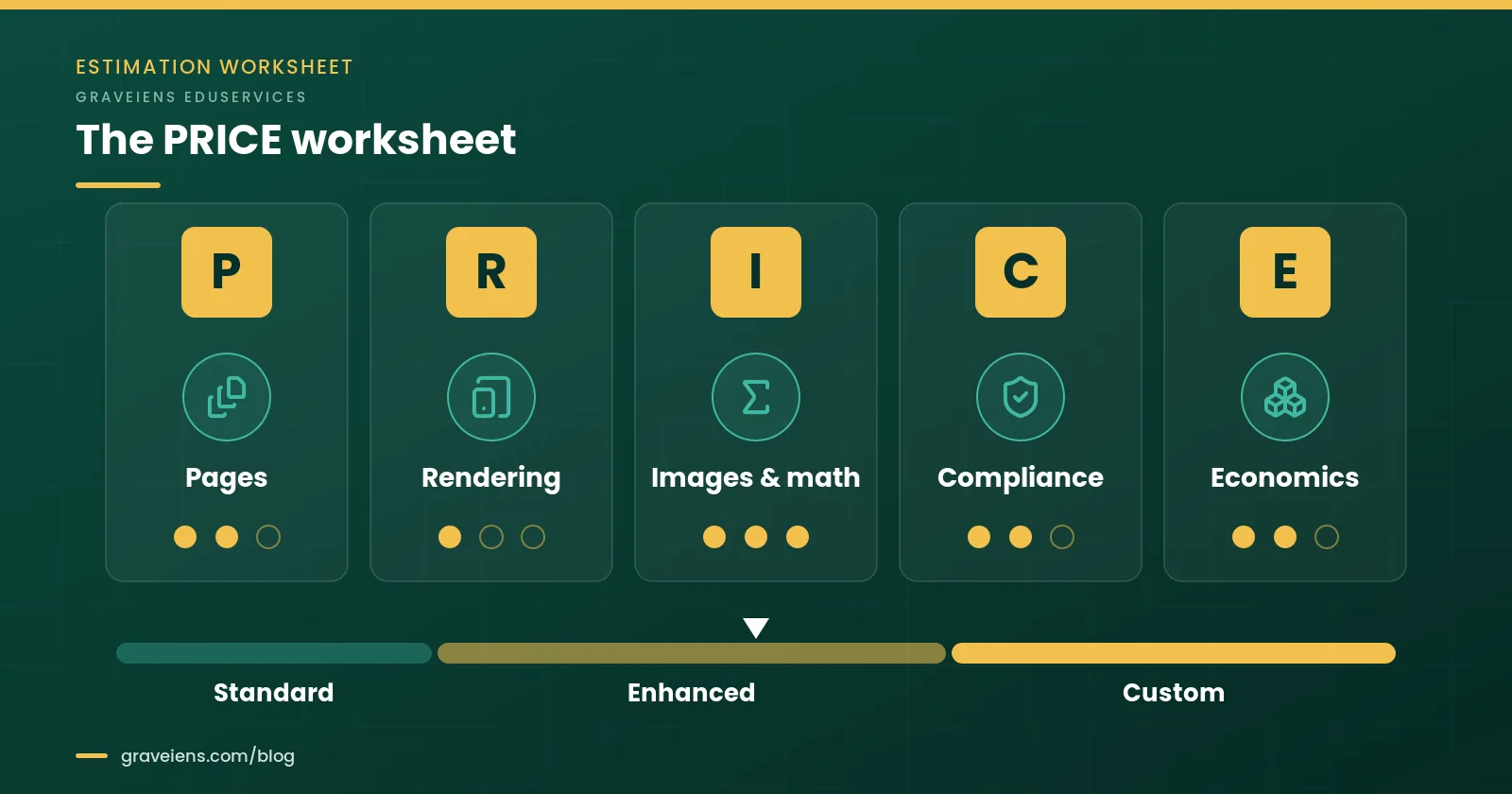
PRICE is a five-factor worksheet for estimating conversion effort before you contact vendors. Score Pages, Rendering, Images, Compliance and Economics from 1 (low) to 3 (high). A total of 5 to 7 suggests a standard project, 8 to 11 an enhanced one, and 12 to 15 a custom quote.
| Factor | What you score | Score 1 (low effort) | Score 3 (high effort) |
|---|---|---|---|
| P: Pages and source files | Source file type and quality | Clean InDesign or styled Word | Scans or image-only PDF |
| R: Rendering and layout | Layout and interactivity | Reflowable, no media | Fixed layout, media overlays or scripted activities |
| I: Images and math | Figures, tables, math and notes per page | Mostly running text | Dense STEM pages with equations and figures |
| C: Compliance and QA | Accessibility claim and QA depth | Accessible structure, required metadata, EPUBCheck pass | Conformance claim plus extended descriptions and full manual testing |
| E: Economics | Volume, schedule and languages | Batch of similar titles, flexible dates, one language | One-off design, rush schedule, several scripts |
Use 2 for anything in between. Then read the total as a guide to the pricing model, not as a price:
- Standard (5 to 7): a simple per-page rate usually fits.
- Enhanced (8 to 11): expect a per-page base plus priced add-ons such as MathML, alt text or audio sync.
- Custom (12 to 15): ask for a per-title quote after a sample conversion.
Here is an illustrative example, not a client project. An undergraduate statistics textbook has InDesign files for most chapters but only PDF for two (P = 2). It will ship as reflowable EPUB with no media (R = 1). Most pages hold equations and tables (I = 3).
It sells in the EU, so the publisher wants a documented EPUB Accessibility 1.1 claim (C = 2). It is a single title on a normal schedule in one language (E = 2). The total is 10, an Enhanced project.
That score tells the publisher three things. Ask for MathML as a priced line item. Send the two PDF-only chapters as part of the sample. Budget for a per-page base plus add-ons, not a flat rate.
Score every title in a backlist the same way. Titles with matching scores and designs can be grouped into batches, which is where volume savings come from.
In short: PRICE turns a vague question about EPUB conversion cost per page into five answers a vendor can price.
Scored a title with PRICE? Test the result on real files. Send 3 sample pages from its hardest chapter for a free sample conversion and a scoped quote. Request the PRICE checklist (mention “PRICE checklist” in your message and we’ll email the one-page PDF).
How do you get an accurate EPUB conversion quote?
Send a written spec with 3 representative sample pages or one chapter, including your hardest content. State the source files you hold, page counts, target layout, accessibility target, content inventory, QA expectations, volume and deadlines. Ask each vendor to convert the sample and list every assumption before pricing the full job.
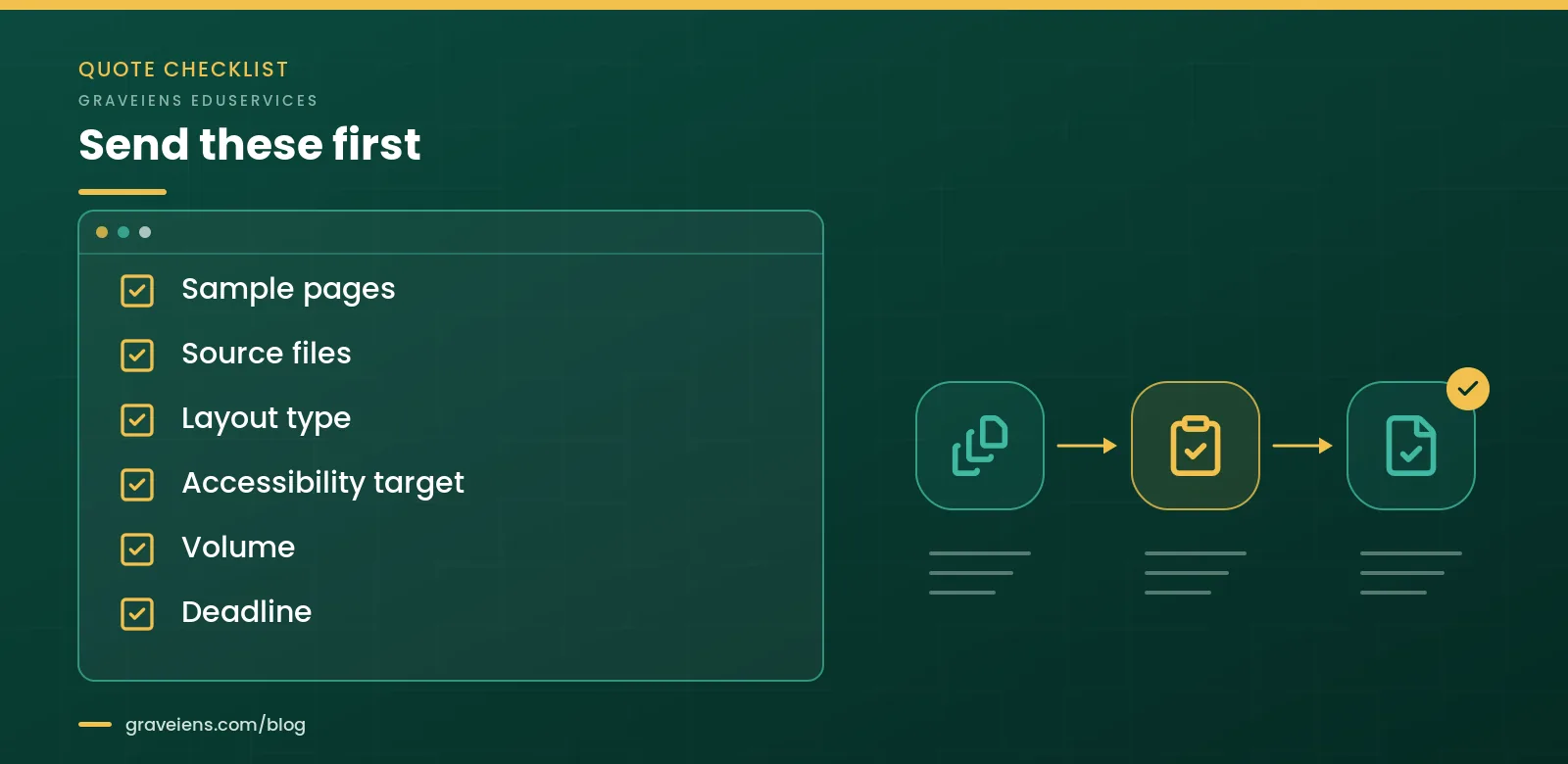
Use this spec checklist for every request:
- Sample pages. Three representative pages or one chapter, including the hardest tables, figures and equations.
- Source files. What you hold for each title: InDesign packages with fonts and links, Word, PDF or scans.
- Page and title counts. Pages per title and the counting rule you used.
- Target output. Reflowable or fixed layout, EPUB version and the retailers or platforms you deliver to.
- Content inventory. Approximate counts of tables, equations, figures, notes, index entries and media files.
- Accessibility target. The conformance claim you need, who writes alt text and whether complex images need extended descriptions.
- Style and navigation. House style, table of contents depth and whether you need a page list mapped to print page numbers.
- QA expectations. EPUBCheck results, an Ace by DAISY report and the reading apps and screen readers to test.
- Volume and schedule. Batch sizes, delivery dates and any fixed launch dates.
- Review and corrections. How many correction rounds are included and how changes will be sent.
When the quotes come back, compare them line by line with these questions:
- What counts as a page, and which tier is each chapter in?
- Which add-ons are priced separately, and at what unit?
- Are alt text, MathML and accessibility metadata included?
- Which validation reports come with delivery?
- How many correction rounds are included, and what does an extra round cost?
- Do you receive the final EPUB source files with no restrictions?
In short: the same spec and the same sample let you compare vendors on scope, not on headline rates.
What mistakes push EPUB conversion costs up?
Most budget overruns come from habits that raise EPUB conversion cost per page after the quote is agreed:
- Sending a PDF when you hold InDesign files. The vendor rebuilds structure that already exists in your source files.
- Quoting from page count alone. Without a sample, hard pages surface mid-project as change requests.
- Treating accessibility as a later project. Retrofitting means reopening every finished file.
- Leaving alt text ownership open. Descriptions written late hold up delivery and often need a second review.
- Choosing fixed layout by default. It costs more per page and limits reflow, so reserve it for design-led titles.
- Changing content after conversion starts. Author corrections to converted files cost more than fixes made in the source first.
- Converting a backlist one title at a time. Batching titles that share a design spreads setup costs across the series.
- Skipping validation to save money. A file that fails EPUBCheck or a reader test goes back into production, and you pay twice.
In short: fix the source, lock the spec and plan accessibility from the start. Each of these protects the per-page price you agreed.
How GravEiens EduServices quotes EPUB conversion
At GravEiens EduServices, pricing follows a scoped spec. We do not quote a flat rate before we have seen your files. We start with a free sample conversion of 3 pages or one chapter, then write the spec and the quote together.
Our EPUB conversion services cover reflowable EPUB 3, fixed-layout EPUB, MathML and alt text. Validation steps and reports are written into the spec, so you know exactly what you will receive.
Every project runs through our four-stage QA workflow: content creation, internal review, client review and final delivery. Our quality management system is ISO 9001 certified.
Founded in 2017, GravEiens EduServices has served 350+ global clients with a team of 700+ experts and delivered more than 2 million digital assets. For formats, platforms or volumes outside this list, we scope the work with you.
Frequently asked questions
How much does EPUB conversion cost per page?
There is no single rate that fits every book. EPUB conversion cost per page depends on source files, layout, tables, math, images, linking, interactivity, the accessibility target, QA depth, volume, turnaround and language. The reliable way to get a number is to send a spec and sample pages, then ask the vendor to price that scope in writing.
Is fixed-layout EPUB more expensive than reflowable EPUB?
Usually, yes, per page. Fixed-layout EPUB keeps every page exactly as designed, so each page must be positioned and checked across devices. Reflowable EPUB effort scales with structure instead of design. Fixed layout also needs extra work to be accessible. Choose it when the design carries meaning, such as in picture books or comics.
Does PDF to EPUB cost more than converting from InDesign?
Generally, yes. A PDF records where text sits on a page but not its reading order, so headings, lists, tables and notes must be rebuilt. InDesign files with paragraph styles map more directly to structured markup. Scanned PDFs cost the most, because each page needs OCR and proofreading before conversion starts.
Does accessibility add to EPUB conversion cost?
It adds some effort, and the amount depends on the claim you need. Accessible structure and the schema.org metadata that EPUB Accessibility 1.1 requires cost little extra during conversion. A documented conformance claim at WCAG AA, extended image descriptions and manual testing add more. Retrofitting finished files later is usually the most expensive route.
Why do EPUB conversion quotes differ so much between vendors?
Quotes differ because vendors assume different scopes. One rate may include alt text, MathML, index linking and screen reader testing, while another prices each as an add-on or leaves it out. Page counting rules also vary. Send every vendor the same spec and sample pages, then compare line items rather than headline rates.
Is backlist conversion cheaper per page?
It often is, when titles share a design. Setup work such as style mapping, CSS templates and conversion scripts can be reused across a series, which spreads that cost. Scanned or inconsistent backlist titles can still be costly per page. Score each title with a worksheet such as PRICE and group similar titles into batches.
How long does EPUB conversion take?
Timelines depend on page count, complexity, volume and review rounds. A short reflowable title moves faster than a math-heavy textbook with extended image descriptions. Rush schedules are possible but add cost, because more people work in parallel. Agree delivery dates per batch in the spec, and allow time for your own review.
Get a scoped quote you can budget against
Send 3 sample pages or one chapter from your hardest title. We will return a free sample conversion and a scoped quote, with every assumption written down.
Sources
- W3C, EPUB 3.3, W3C Recommendation (latest version dated 13 January 2026): https://www.w3.org/TR/epub-33/
- W3C, EPUB Accessibility 1.1, W3C Recommendation, 17 October 2024.
- W3C and DAISY Consortium, EPUBCheck, the official conformance checker for EPUB publications.
- DAISY Consortium, Ace by DAISY, EPUB accessibility checker.
- European Commission, European Accessibility Act (EAA).
- Directive (EU) 2019/882 on the accessibility requirements for products and services, EUR-Lex: https://eur-lex.europa.eu/eli/dir/2019/882/oj/eng
- Federation of European Publishers, Accessibility (European Accessibility Act and e-books): https://fep-fee.eu/-Accessibility-89-
About the author
GravEiens EduServices Editorial Team. Our editorial team writes about digital publishing, EPUB conversion and accessible content for K-12, higher education and professional publishers. The team draws on the conversion specialists, subject experts and QA reviewers who deliver GravEiens EduServices projects.

 EdTech Outsourcing
2D Educational Animation Services: Process, Styles, and How to Brief Them
How 2D educational animation services actually work: styles, pipeline, briefing tips, cost drivers, and mistakes to avoid before you hire…
 EdTech Outsourcing
Education Outsourcing Companies: How to Choose the Right Content Partner
Compare education outsourcing companies with the 7-point PARTNER check, a pilot-first process, cost drivers and red flags. Request a free…
Get monthly EdTech insights
Trends, content tips and how-tos — once a month, no spam.