Last updated: November 2026
Key takeaways
- Higher education course development services turn faculty expertise into finished online or hybrid courses. The work covers design, media, LMS build, assessments, accessibility and quality review.
- A sound build runs in six phases: discover, map outcomes, storyboard, build, accessibility QA and pilot. Skipping the pilot is the most common cause of first-term fixes.
- Cost is driven by interactivity, media, assessments, faculty time, accessibility and platform work. Ask partners to price each driver separately.
- Use the 5C Course Build Fit Test to choose between in-house teams, an OPM and a fee-for-service partner: control, capacity, cash model, calendar and compliance.
- Build to the rules from day one. U.S. teams face distance education interaction rules and ADA Title II deadlines. UK teams work with the QAA Quality Code.
Online program teams are asked to launch more courses with the same small staff. Faculty experts have limited time, instructional designers are stretched, and every course must meet accessibility and quality standards before students log in. Higher education course development services fill that gap by adding design, media and build capacity when you need it.
This guide explains how those services work. It covers the process, team roles and a simple test for choosing a delivery model. It also covers real cost drivers and the compliance mistakes that cause rework. It is written for U.S. and UK universities, online program teams and OPMs.
Planning a new program or a course refresh? Request a free sample task and see how we storyboard one module.
What are higher education course development services?
Higher education course development services are outsourced or blended teams that design and build credit-bearing courses with your faculty. They turn a syllabus and subject expertise into a finished course in your LMS. Typical scope includes outcome mapping, storyboards, media, assessments, accessibility checks and a quality review against a rubric such as Quality Matters.
The faculty member stays the subject expert and academic owner. The partner supplies the design, production and project management that most departments cannot staff full time.
Services usually fall into four groups:
- Design: learning outcomes, course maps, storyboards and assessment plans.
- Production: video, graphics, interactive activities and readings.
- Build: LMS setup, gradebook, release rules and testing.
- Quality: accessibility remediation, copyediting and rubric-based review.
If you are comparing providers, our overview of instructional design companies explains how specialist firms differ.
In short: these services add design and build capacity around your faculty, so courses launch on time and meet standards.
How does the course development process work?
Strong higher education course development services follow six phases: discover, map outcomes, storyboard, build, accessibility QA and pilot. Each phase ends with a sign-off, so faculty review small pieces instead of a finished course. That structure protects faculty time and catches design problems before they become expensive build problems.
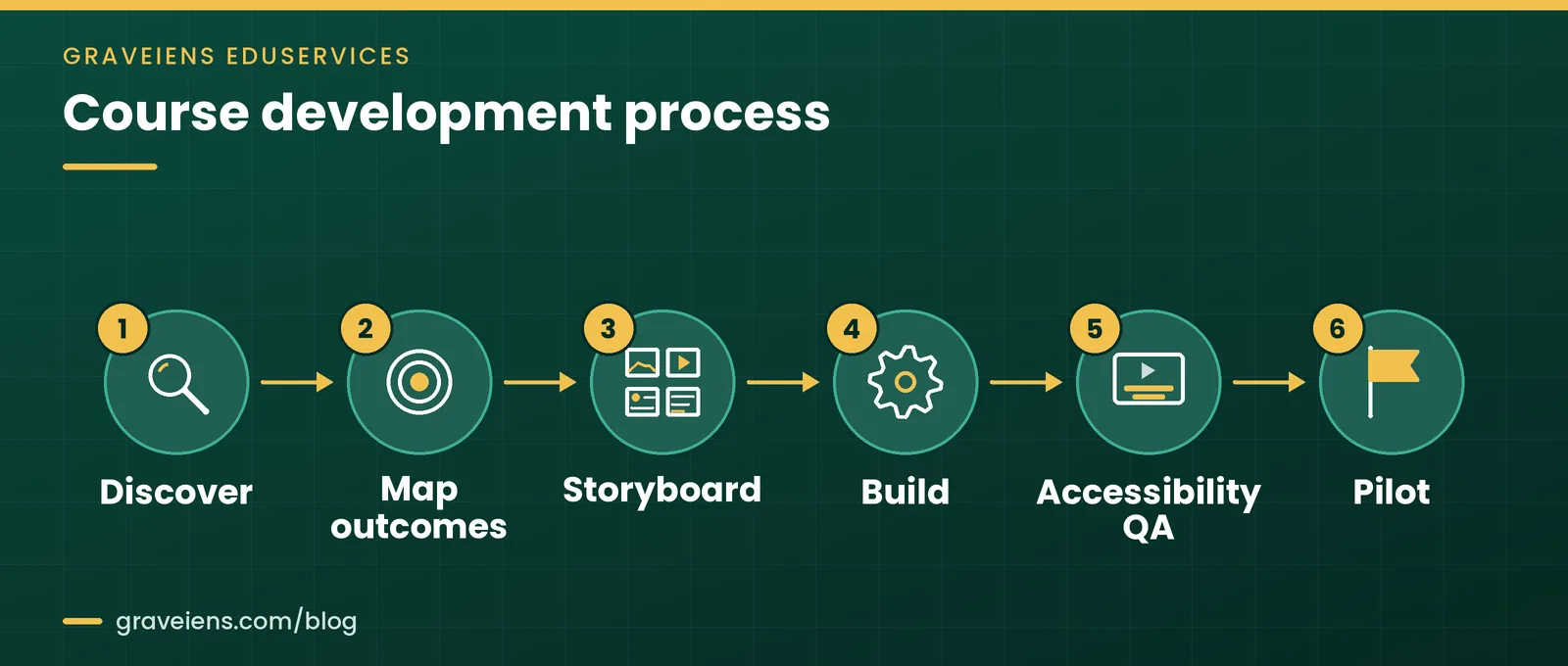
- Discover. Confirm the audience, credit load, modality, LMS and launch date. Collect existing materials and program outcomes.
- Map outcomes. Write measurable module outcomes and align each one to activities and assessments.
- Storyboard. Plan each module page by page: readings, media, activities, discussion prompts and grading.
- Build. Produce media and assemble the course in the LMS, following the approved storyboards.
- Accessibility QA. Check documents, video captions, color contrast, headings and keyboard access against your standard.
- Pilot. Run the course, or a module, with real students. Collect feedback and fix issues before full launch.
How much faculty time should you plan for?
Faculty time is the scarcest input in any course build. Book review slots for each sign-off before the project starts. Ask the partner to draft from existing lecture notes, slides or recordings where possible. That way faculty edit and approve instead of writing every page from scratch.
In short: six phases, six sign-offs. Faculty review storyboards early, when changes are cheap.
Who does what on a course development team?
Most higher education course development services staff six roles: faculty subject matter expert, instructional designer, media developer, LMS developer, accessibility specialist and QA reviewer. On small projects one person may cover two roles. The partner should name who fills each role and how much faculty time each phase needs.
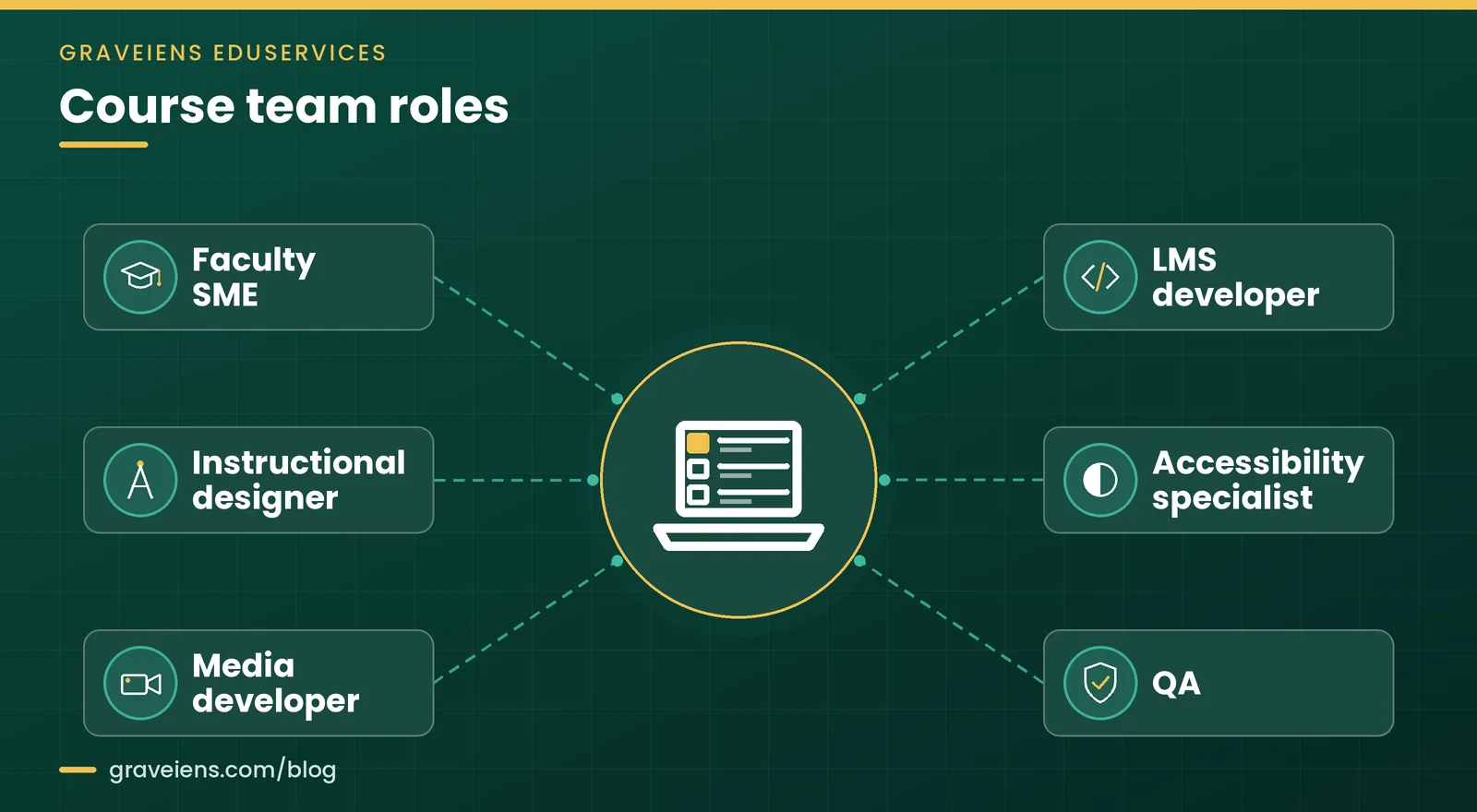
- Faculty SME: owns the content and academic judgment, and approves each phase.
- Instructional designer: maps outcomes, writes storyboards and guides the faculty member.
- Media developer: produces video, graphics and interactive elements.
- LMS developer: builds pages, quizzes, gradebook settings and release rules.
- Accessibility specialist: checks and fixes documents, media and pages.
- QA reviewer: tests links, settings and content against the storyboard and rubric.
Our instructional designers work in this model every day. See our instructional design services for how we staff each role.
Which delivery model fits: in-house, OPM or partner?
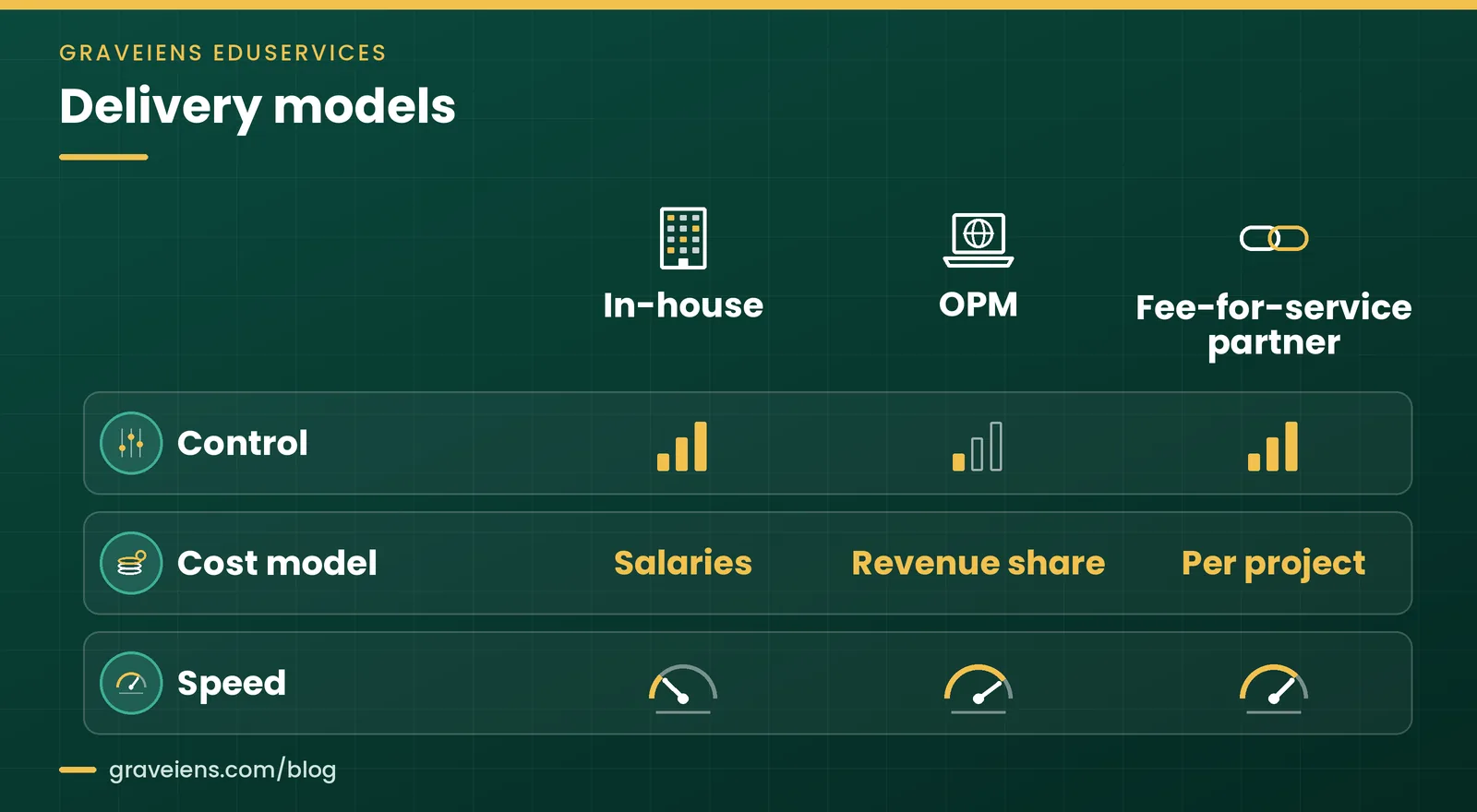
Choose the model by asking who keeps control, how costs are paid and how fast you need courses. In-house teams give the most control. An OPM may fund upfront costs for a longer contract. A fee-for-service partner offers speed while the university keeps ownership. Before you buy higher education course development services, run the 5C Course Build Fit Test.
The 5C Course Build Fit Test
- Control. How much say do you need over design, branding and data? In-house and fee-for-service keep control with you. OPM contracts may share it.
- Capacity. Can your current designers absorb the work without delaying other courses? If not, you need outside help.
- Cash model. Can you pay for development up front, or do you need a partner to fund it? Revenue-share deals shift upfront cost but last longer.
- Calendar. How many courses must launch, and by when? A partner can add capacity for a launch peak without permanent hires.
- Compliance. Who will document accessibility and interaction standards? Make it a named deliverable, whatever the model.
Many teams mix models. They keep strategy and faculty relations in-house and bring in a partner for build capacity. Our guide to education outsourcing companies covers what to check before you sign.
In short: if control and ownership matter most and you can fund development, a fee-for-service partner alongside your in-house team is often the best fit.
Weighing a partner for your next launch? Get a scoped quote for one course, priced by each cost driver.
What drives the cost of higher education course development services?
Six factors drive most of the cost: interactivity, media, assessments, faculty SME time, accessibility and platform work. A text-and-discussion course costs far less to build than one with custom simulations and studio video. Ask every partner to price these drivers separately so you can see what you are paying for and where to trim.
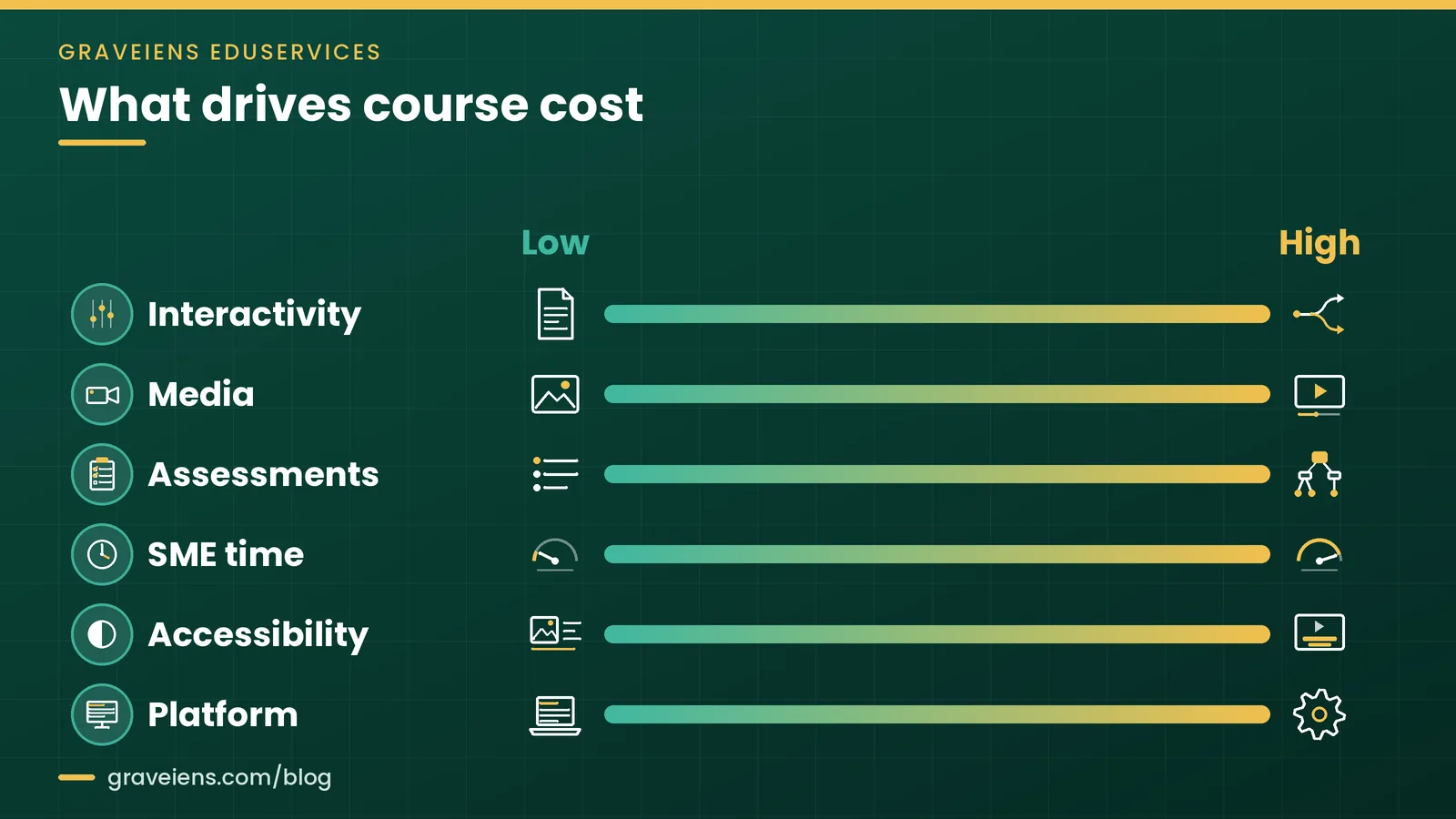
| Cost driver | Lower effort | Higher effort | Question to ask |
|---|---|---|---|
| Interactivity | Readings and discussions | Simulations, branching scenarios | Which activities need custom builds? |
| Media | Slides with voiceover | Studio video, animation | How many minutes of new video? |
| Assessments | Reused quizzes | New item banks, rubrics, case tasks | How many new items and rubrics? |
| SME time | Ready syllabus and notes | Content written from scratch | How many faculty hours per module? |
| Accessibility | Born-accessible new files | Legacy PDFs, STEM figures | How much existing content needs fixing? |
| Platform | Standard LMS template | Custom tools and integrations | Which third-party tools are embedded? |
SME time is the hidden driver. When faculty must write content from scratch, timelines stretch. A partner that drafts from lecture notes or recordings can reduce that load.
In short: price by driver, not by course. Two courses with the same credit hours can differ widely in effort.
Compliance and quality mistakes to avoid
Most rework in higher education course development services comes from rules that were not built into the storyboard. Here are the standards to plan for, with their status as of November 2026.
- Weak instructor interaction (U.S.). Per 34 CFR 600.2 (eCFR current as of October 2026), distance education must support regular and substantive interaction. Substantive interaction includes at least two of five listed activities, such as direct instruction or feedback on coursework. Design these into the course, not just the syllabus.
- Treating accessibility as a final step. Per the Federal Register interim final rule of April 20, 2026, ADA Title II web deadlines have moved. Public entities serving 50,000 or more people now have until April 26, 2027. Smaller ones have until April 26, 2028. A legal challenge to the extension was pending as of November 2026. Many public universities will need to plan for the earlier date. Our ADA Title II deadline guide explains the details.
- Skipping a rubric review. Quality Matters lists eight General Standards and 44 Specific Review Standards in its Higher Education Rubric, Seventh Edition. Certification requires all Essential Standards plus 85% of possible points. Even without certification, the rubric is a useful checklist.
- Ignoring UK partnership rules. The UK Quality Code for Higher Education (2024) sets 12 Principles. Principle 7 covers programme design and approval. Principle 8 expects written partner agreements signed before a programme starts.
- Unclear content ownership. State in the contract that the university owns all course materials and source files.
In short: put interaction, accessibility, rubric and ownership requirements into the statement of work before the first storyboard.
How GravEiens EduServices approaches higher education course development
GravEiens EduServices has built learning content since 2017 for publishers, universities and EdTech companies. Our quality system is ISO 9001 certified.
Every course runs through our four-stage QA: content creation, internal review, client review and final delivery. Faculty approve storyboards and sample modules before full build, so there are no surprises at launch.
We deliver higher education course development services as a fee-for-service partner. Your university keeps control of content and brand, and we add the design, media, build and accessibility capacity your team needs. Explore our higher education content services for more detail.
Frequently asked questions
How long does it take to develop an online course?
It depends on scope, media, faculty availability and how much content already exists. A course built from a ready syllabus with reused materials moves much faster than one written from scratch with custom video. Plan by phase, book faculty review time early, and leave room for an accessibility check and a pilot before the first full term.
How much do higher education course development services cost?
Cost depends on six drivers: interactivity, media, assessments, faculty time, accessibility and platform work. A text-and-discussion course needs far less effort than one with simulations and studio video. Ask partners to quote each driver separately for one sample course. That shows where the budget goes and which features you can scale back if needed.
What is the difference between an OPM and a course development partner?
An online program manager, or OPM, often bundles marketing, recruitment and course development. Some OPMs are paid through a share of tuition over several years. A course development partner usually works fee-for-service on defined courses. The university pays for the work it needs and keeps full control of content, brand and data.
Who owns the course content when a partner builds it?
Ownership depends on your contract, so put it in writing. Most universities require that all course materials, source files and media become university property on payment. Also confirm rights to any stock media, fonts or third-party tools used in the build. Ask for editable source files so your team can update the course later.
Do online courses need to meet Quality Matters standards?
Quality Matters is voluntary, but many institutions use its rubric as a design benchmark. The Higher Education Rubric, Seventh Edition, has eight General Standards and 44 Specific Review Standards. Certification requires meeting all Essential Standards and 85% of possible points. Building to the rubric from the storyboard stage makes later review much easier.
Do UK universities have to follow the QAA Quality Code?
It depends on the nation. Per QAA, the Quality Code is a key reference point for quality in Scotland, Wales and Northern Ireland. In England, providers must comply with the Office for Students’ regulatory framework, and engaging with the Code is voluntary for most providers. Many still use it to shape course design and approval processes.
Build your next course with us
Send us one module outline or syllabus. We will return a sample storyboard and a scoped quote priced by cost driver, reviewed through our four-stage QA. Request your free sample task today.
Sources
- Quality Matters, “Higher Ed Course Design Rubric,” Seventh Edition
- eCFR, 34 CFR 600.2 Definitions (distance education; regular and substantive interaction)
- QAA, “UK Quality Code for Higher Education,” June 2024
- U.S. Department of Justice, Title II web and mobile compliance date extension, Federal Register, April 20, 2026
GravEiens EduServices Editorial Team
The GravEiens EduServices Editorial Team includes instructional designers, media developers and accessibility specialists who build online and hybrid courses with university faculty. We write from live project experience and check every standard and deadline against primary sources.

 Academics
7 Best Explainer Video Ideas for EdTech Organisations
In the age of educational content being available at the fingertips on multiple platforms, learners have tons of options to…
 Academics
11 Effective Tips to Create Educational Videos for College Students
The evidence that videos enhance education is irrefutable. According to a 2015 study, 93% of teachers believe that video improves…
 Online Learning
How to Develop Content in Your EdTech Firm as per New National Education Policy 2023: A Guide from GravEiens
Proposed in 2020, the new National Education Policy was implemented in the 2023-24 academic session. As per the new curriculum,…
Get monthly EdTech insights
Trends, content tips and how-tos — once a month, no spam.