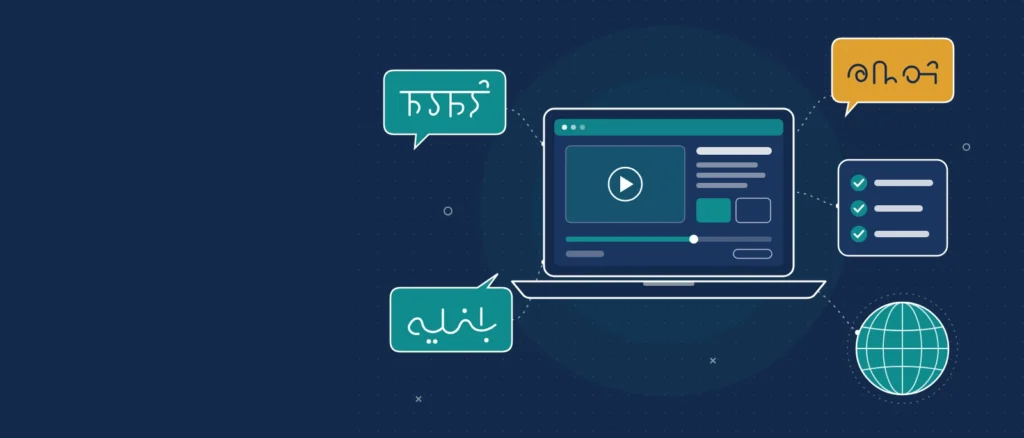
eLearning localization services adapt a digital course’s text, audio, video, visuals, interactions and assessments to a new language and culture, then rebuild and test it so it runs in the learner’s LMS exactly as the original does.
For Indian L&D teams and EdTech companies, that usually means Hindi plus a few regional languages, layouts that render Indic scripts correctly, and quizzes that measure the same skill in every language. This guide covers what the work includes, how depth tiers compare, what drives cost, and a scoring model for deciding how far to go.
At a glance
| Question | Short answer |
|---|---|
| What do eLearning localization services include? | Translation, cultural adaptation, voice or subtitles, layout engineering, assessment adaptation, LMS packaging and in-context QA. |
| Is it the same as translation? | No. Translation changes words; localization also changes examples, media, formats and interactions. |
| How long does it take? | Commonly 2 to 8 weeks per language, driven by voice-over and review cycles. |
| What drives cost most? | Audio decisions, then word volume, engineering and review rounds. |
| Which approach is best? | It depends on learner risk, assessment stakes and course lifespan. Use the LOCALE score. |
| Can AI do it? | AI speeds up drafts. Human post-editing and in-context review remain essential for compliance, safety and graded content. |
Contents
- What are eLearning localization services?
- Why eLearning localization matters in India
- Four depth tiers compared
- How eLearning localization works
- The LOCALE Readiness Score
- Illustrative examples
- What eLearning localization services cost
- Common mistakes
- Pre-brief checklist
- How to evaluate eLearning translation and localization services
- FAQ
- Conclusion
What are eLearning localization services?
eLearning localization is the process of making an online course feel built for learners in a specific language and region. A vendor translates text and narration, replaces unfamiliar examples, reformats dates, numbers and currency (for example, lakh and crore), rebuilds screens for longer or right-to-left text, adapts assessments, and republishes a working SCORM, xAPI or cmi5 package.
Translation changes only the words. Internationalization prepares the source course before translation: buttons with room to grow, no text baked into images, Unicode fonts. Localization sits between the two and covers everything the learner sees and hears.
Why eLearning localization matters in India
India’s Constitution lists 22 languages in its Eighth Schedule, and a single plant or retail network often spans several. An English course reaches only part of that workforce, and formal textbook Hindi can miss workers who speak everyday, English-mixed Hindi.
Policy points the same way. NEP 2020 says the medium of instruction until at least Grade 5, and preferably till Grade 8 and beyond, should be the home language or regional language. For publishers serving K-12 schools, regional editions are becoming a requirement.
Tools are improving too. Digital India BHASHINI, under the Ministry of Electronics and Information Technology, reported 36 text languages and 23 voice languages in March 2026. Such tools speed up drafts but do not replace glossary control or testing inside the course.
Also read: Translating Content in Various Indian Languages: 10 Techniques
Four depth tiers compared
Not every course needs full localization. This matters most for high-volume corporate compliance and onboarding programs, where one choice repeats across thousands of seats.
| Tier | What changes | Best for | Trade-off |
|---|---|---|---|
| 1. Subtitles only | Captions | Short videos, internal updates | On-screen English remains |
| 2. MT with human post-editing | Text, captions, quizzes | Software training, desk staff | Examples may feel foreign |
| 3. Full localization | Text, voice, visuals, formats, assessments | Compliance, safety, customer skills | Highest cost and time |
| 4. Transcreation | Scenarios and structure rebuilt | Sales, behaviour change, K-12 | Needs a designer, not only a linguist |
A hybrid is common: Tier 3 for modules carrying legal or safety risk, Tier 2 for the rest.
How eLearning localization works
1. Internationalization audit. Find text in images, fixed-width buttons and missing source files. Courses built with reuse in mind through sound eLearning content development cost far less to localize.
2. Glossary and style guide. Fix terms, register and which English words stay English.
3. Extraction. Export strings to XLIFF or Word.
4. Translation and adaptation. Human translation or machine translation with full post-editing, plus new names, examples and visuals.
5. Audio and video. Adapt scripts, cast native voices, record or subtitle, re-time animations.
6. Engineering. Re-import text, fix overflow, apply fonts, mirror right-to-left layouts.
7. In-context QA. A native reviewer checks every screen, branch and quiz in the running course.
8. LMS testing. Test completion, scoring, bookmarking and resume for each language.
What the tools miss
Articulate’s guide to translating Storyline 360 courses lists closed captions, trigger conditions, player labels and variable names among items the text export does not handle, and Articulate Localization does not translate text inside images, video or PDFs. Someone must fix these by hand.
Layout needs room. W3C guidance on text size in translation, citing IBM figures for English to European languages, shows strings under 10 characters can grow 200 to 300%, so buttons break first. Indic vowel signs sit above and below the letter, so tight line spacing clips them. Each build must also report correctly as a SCORM-compliant or xAPI (IEEE 9274.1.1-2023) package.
Also read: Closed Captioning vs Subtitling: The Difference Between Two Localisation Services
The LOCALE Readiness Score
The LOCALE Readiness Score is a six-factor model for deciding how deep eLearning localization should go per course. Score each factor 1 (low) to 5 (high).
| Factor | Question | Scores 5 when |
|---|---|---|
| L: Learner risk | What if a learner misunderstands? | Injury, legal breach or failed grade |
| O: Output complexity | How much audio, video and branching? | Narrated video, simulations |
| C: Cultural distance | Do examples fit the audience? | Scenarios and norms feel foreign |
| A: Assessment stakes | How are results used? | Certification or compliance record |
| L: Learner access | Literacy, device, accessibility needs? | Mixed literacy, mobile-only, assistive tech |
| E: Expected lifespan | How long and how often updated? | Multi-year, updated quarterly |
Reading the total (6 to 30): 6 to 12 suits Tier 1 or 2. 13 to 21 suits Tier 2 with full localization for high-risk modules and graded tests. 22 to 30 calls for Tier 3 or 4, plus a glossary and translation memory, because the course will be revisited.
A high A score means items need equivalence, not literal translation, which is specialist assessment authoring work. A high Learner access score means captions, alt text and language tags are rebuilt per language: WCAG 2.2 success criteria 3.1.1 and 3.1.2 require page and passage language to be programmatically determinable, so accessibility remediation belongs inside the plan.
Illustrative examples
Illustrative example 1: plant safety induction. A manufacturer’s English safety course serves operators in Maharashtra, Tamil Nadu and Jharkhand. LOCALE score: 26. Decision: Tier 3 into Marathi, Tamil and Hindi with native voice, machine names kept in English to match equipment labels. Expected outcome: fewer quiz errors on hazard steps versus the English baseline.
Illustrative example 2: K-8 maths app. An EdTech platform adds Kannada and Bengali. The risk sits in word problems, where literal translation changes reading load. Decision: adapt items and pilot them with learners before release.
Illustrative example 3: Gulf compliance rollout. An Indian firm extends a course to Arabic-speaking staff. Decision: mirrored right-to-left layouts, Arabic fonts and a separate LMS test for each build.
Reported project: Graveiens reports localizing 60+ hours of corporate eLearning into nine languages, including right-to-left scripts, with 58% higher completion among non-English learners and 99% first-pass linguistic QA. See its case studies.
What eLearning localization services cost
Pricing is usually built per language:
Cost per language = (new words × rate) + (repeated words × reduced rate) + (audio minutes × voice or subtitle rate) + (engineering hours × rate) + (QA hours × rate) + project management
Published reference points: Graveiens lists indicative ranges of $0.10 to $0.25 per word and 30 to 50% of original development cost per language. An eLearning Industry analysis (updated 2021) put a moderately complex 30-minute module at several thousand US dollars per language and 4 to 8 weeks.
Illustrative calculation (hypothetical rates to show the arithmetic, not market prices): 30-minute course, 10,000 words, 25 narrated minutes, one language.
| Line item | Hypothetical input | Cost (₹) |
|---|---|---|
| New words | 7,000 × ₹2.50 | 17,500 |
| Repeated words | 3,000 × ₹0.75 | 2,250 |
| Native voice-over | 25 min × ₹1,500 | 37,500 |
| Engineering and functional QA | 16 h × ₹1,200 | 19,200 |
| In-context review | 6 h × ₹1,000 | 6,000 |
| Project management | 10% | 8,245 |
| Total | 90,695 |
Voice-over is about 41% of the total. Swapping it for subtitles at a hypothetical ₹300 per minute gives ₹57,695, roughly 36% less. The audio decision, not the word rate, is usually the biggest lever.
Also read: How to Choose the Right Localisation Service from India
Common mistakes
Localizing from the published package. Source files get lost, so engineers rebuild screens from scratch. Prevent it by making editable source files a contract deliverable.
Machine translation without a glossary. Deadline pressure skips this step, and safety terms then drift between modules. Approve a bilingual glossary before translation starts.
Literal quiz translation. Grammar can cue the right option or change difficulty. Have a subject expert review every item and distractor in the running course.
Wrong register. Formal Hindi can confuse workers who use English-mixed Hindi daily. Test sample screens with five to ten real learners first.
Skipping per-language LMS tests. A broken completion rule leaves compliance records incomplete. Test launch, pause, resume and completion for every language.
Pre-brief checklist
1. Rank target languages by where learners actually work.
2. Collect editable source files, fonts, scripts and media.
3. Score each course with LOCALE and assign a tier.
4. Approve a glossary and style guide, including register.
5. Flag graded assessments for item adaptation.
6. Choose voice-over, subtitles or both, per module.
7. Name an in-country reviewer with sign-off authority.
8. Define LMS test cases and success metrics, such as completion and first-attempt scores.
If the source course needs restructuring first, involve instructional design early; clearer scripts cut rework in every language.
How to evaluate eLearning translation and localization services
When comparing eLearning translation and localization services, ask for evidence, not language counts:
- Standards: Do they follow ISO 17100 for translation and ISO 18587 for post-editing machine output? ISO 17100 excludes post-editing, so both matter when AI is used.
- Tool fluency: Can they show work in your authoring tool and LMS standard?
- In-context QA: Do native reviewers check running builds, or only spreadsheets?
- Ownership: Will you own the translation memory and glossary?
- Pilot: Will they localize one module first so you can measure quality?
FAQ
What are eLearning localization services?
These services adapt an online course for a new language and culture, covering translation, cultural adaptation, voice-over or subtitles, layout engineering, assessment adaptation and republishing as SCORM, xAPI or cmi5, so the course reads as if it was built for that audience.
What is the difference between eLearning translation and localization?
Translation converts words. eLearning localization also changes examples, names, images, currency, number formats, audio, reading direction and assessment design. A translated course can be accurate yet feel foreign; a localized one should feel native.
How much does eLearning localization cost in India?
Cost depends on word volume, audio minutes, engineering, review rounds and language count, with voice-over often the largest line item. Graveiens publishes indicative ranges of $0.10 to $0.25 per word, but only a scoped quote on your files is reliable.
How long does it take to localize a course?
Graveiens cites 2 to 4 weeks per language for a standard course, while an eLearning Industry analysis cited 4 to 8 weeks for a moderately complex module. Languages can run in parallel; voice recording and client review usually set the final date.
Can AI or machine translation be used?
Yes, for first drafts. AI tools miss text inside images and media and do not know your terminology. For compliance, safety or graded content, use full human post-editing in line with ISO 18587 and in-context review.
Which Indian languages should we localize into first?
Start with the languages learners use at work. Map headcount by location and preferred language, then prioritise where risk and volume are highest. Many organisations begin with Hindi and one or two regional languages, then expand once the glossary exists.
How do you keep localized assessments fair?
Adapt items for equivalence rather than translating literally. A subject expert confirms each question tests the same skill at the same difficulty, that distractors stay plausible, and that grammar does not reveal the answer. Pilot high-stakes items with learners.
About the authors
Prepared by the Graveiens AI Team with input from the localization practice at Graveiens EduServices, a Noida-based education-content company. Learn more about Graveiens.
Reviewed by: [Reviewer name, role and years of localization experience: needs verification]
Methodology: We reviewed ten ranking pages, verified standards and policy claims against primary sources on 24 September 2026, and labelled hypothetical figures. Company figures are as published by Graveiens.
Conclusion
eLearning localization services turn a working course into one that works in another language, culture and LMS, with assessments that still measure the right skill. The decisions that matter most are depth per course, audio format, terminology control and test validity. Score each course with LOCALE, pilot one module, and budget for in-context QA in every language.
If you need courses, video and assessments adapted for Indian or global learners with native linguists, translation memory and per-language accessibility checks, Graveiens can scope a pilot through its localization and translation team.
Sources
- Department of Official Language, Ministry of Home Affairs: Languages included in the Eighth Schedule
- Press Information Bureau (1 August 2022): Education in Mother Tongue, NEP 2020 paragraph 4.11
- Press Information Bureau (12 March 2026): Digital India BHASHINI Division overview
- W3C: Web Content Accessibility Guidelines (WCAG) 2.2
- W3C Internationalization: Text size in translation
- ISO: ISO 17100:2015 Translation services, requirements
- ISO: ISO 18587:2017 Post-editing of machine translation output
- IEEE: IEEE 9274.1.1-2023, xAPI standard
- Articulate: Storyline 360, translating courses
- Articulate: Articulate Localization FAQs
- eLearning Industry: Factors that drive localized eLearning cost and schedule
- Graveiens: localization and translation service page, linked in the conclusion (company-published figures)

 Uncategorized
Differentiated Instruction: Meaning, Strategies, Examples and What the Research Says
Differentiated instruction is a teaching approach in which the teacher keeps one learning goal for every student but adjusts the…
 Uncategorized
CBSE Sample Papers: How to Use Them to Actually Raise Your Board Exam Score
CBSE sample papers are the official practice question papers that the Central Board of Secondary Education publishes each year, together…
 Uncategorized
PDF to EPUB: How to Convert, When It Works, and When You Need a Professional
PDF to EPUB is the process of turning a fixed-page PDF into a reflowable EPUB file so the text adapts…
Get monthly EdTech insights
Trends, content tips and how-tos — once a month, no spam.