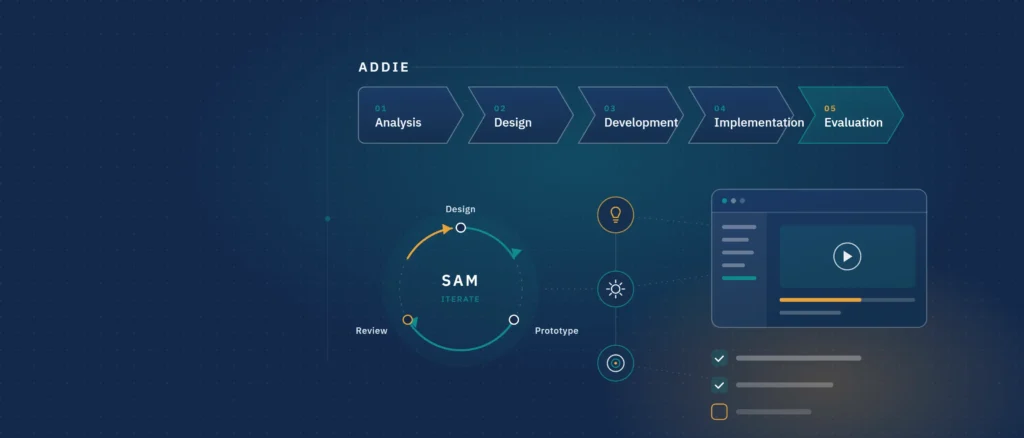
Instructional design models are structured frameworks that guide how learning experiences are analysed, designed, developed, and evaluated, so courses reliably help people learn. They give teams a repeatable process instead of building training by guesswork, and each model offers a different balance of structure, speed, and flexibility.
This guide explains the major frameworks in plain language, groups them by type, compares them side by side, and gives you a practical framework for choosing the right one. Whether you are building a compliance course, a school curriculum, or a corporate academy, the model you choose shapes how efficient and effective the build will be.
Instructional design models at a glance
| Question | Short answer |
|---|---|
| What are instructional design models? | Structured frameworks for analysing, designing, building, and evaluating learning. |
| Which is most common? | ADDIE, a five-phase model widely used across education and corporate training. |
| Which is most agile? | SAM (Successive Approximation Model), built on rapid prototyping and feedback. |
| How is it different from ISD? | Instructional system design (ISD) is the broader process; models are the frameworks inside it. |
| Who created ADDIE and SAM? | ADDIE grew out of 1970s US military and Florida State University work; SAM was developed by Michael Allen. |
| How do I choose? | Match the model to your timeline, complexity, stakes, and how much iteration you need. |
What are instructional design models?
Instructional design frameworks are step-by-step methods that describe how to create effective learning experiences. They take the practice of instructional design, the discipline of turning content and goals into structured learning, and make it repeatable, so a team can plan, build, and improve a course with a shared method rather than starting from scratch each time.
Every model answers the same core questions in its own way: who are the learners, what should they be able to do, how will we teach it, and how will we know it worked. Some models are linear, moving through fixed phases in order; others are iterative, cycling through quick prototypes and feedback. Choosing well is the first real decision in any serious instructional design project.
Good models keep three things aligned: the learning objectives, the activities, and the assessment. When those three match, learning is measurable and the course actually changes performance, which is the backbone of every course our learning solutions team ships.
| Also read: Objectives are the starting point of every model. Our guide to Bloom’s taxonomy verbs shows how to write the measurable objectives that these frameworks depend on. |
Types of instructional design models
Not every framework does the same job. It helps to group these frameworks by the type of problem they solve, because most real projects combine two or three.
| Type | What it does | Example models |
|---|---|---|
| Process models | Structure the whole design and development lifecycle | ADDIE, Dick and Carey, Kemp |
| Iterative / agile models | Build through rapid prototyping and feedback | SAM, Agile design |
| Lesson-level models | Structure the events inside a single lesson | Gagne’s Nine Events |
| Principle-based models | Guide instruction around tasks and problems | Merrill’s First Principles, 4C/ID |
| Objective and outcome models | Define what learners should achieve | Bloom’s Taxonomy, Understanding by Design |
| Motivation models | Keep learners engaged | ARCS (Keller) |
| Evaluation models | Measure whether training worked | Kirkpatrick’s Four Levels |
Reading this table top to bottom shows that these models are complementary, not rival options. A mature project might use ADDIE to run the build, Gagne inside each module, Bloom to write outcomes, ARCS to keep learners engaged, and Kirkpatrick to prove impact.
Instructional design vs instructional system design
These terms are related but not identical. Instructional system design (ISD) is the broad, systematic process of creating instruction, while the models are the specific frameworks used within that process. In other words, ISD is the discipline; ADDIE and SAM are models that put the discipline into practice.
Instructional system design treats a course as a whole system: inputs, processes, and outcomes that must work together. It emphasises analysis before building, and evaluation after, so the training solves a real performance problem rather than just delivering content. Most instructional system design work follows a model like ADDIE to give that system a concrete structure.
The practical takeaway is simple. Instructional system design means the rigorous, end-to-end approach; the models are the named frameworks you choose from. Strong eLearning content development depends on applying a sound instructional system design mindset through a well-chosen model.
The ADDIE model
The ADDIE model is a five-phase instructional design framework whose phases are Analysis, Design, Development, Implementation, and Evaluation. It grew out of instructional systems work developed for the US military in the 1970s and refined at Florida State University, and it is widely regarded as the most commonly used of all these models.
- Analysis: identify the learners, the performance gap, and the learning objectives.
- Design: plan the structure, strategy, assessments, and media.
- Development: build the actual content, activities, and courseware.
- Implementation: deliver the course and roll it out to learners.
- Evaluation: measure results and improve, both during and after.
The ADDIE model is popular because it is thorough and easy to follow. Each phase produces an output that feeds the next, which keeps large projects organised. It suits asynchronous and high-stakes training, such as compliance or certification, where a structured, documented process matters.
The main criticism of the ADDIE model is rigidity. Because the phases are sequential, changing direction late can be slow. Modern teams often run the ADDIE model in a lighter, looping way, prototyping earlier and evaluating throughout. Even so, the classic ADDIE model remains the backbone of most custom eLearning development, because its discipline is hard to beat for complex builds.
The SAM model
The SAM model, or Successive Approximation Model, is an iterative instructional design framework built on rapid prototyping and continuous stakeholder feedback. It was developed by Michael Allen of Allen Interactions as an agile alternative to ADDIE, and it is one of the best-known iterative design models in use today.
Where ADDIE is linear, the SAM model in instructional design is a loop. SAM has three broad stages, Preparation, Iterative Design, and Iterative Development, but the heart of it is the cycle: a team creates a quick prototype, gathers feedback, and improves it, repeating until the course is right. This makes SAM fast, collaborative, and forgiving of change.
The trade-off is that SAM needs active, available stakeholders and can feel less predictable than a linear plan. It shines for rapid eLearning, synchronous training, and situations where speed and adaptability matter most. In practice, SAM and a light version of ADDIE often look similar, both prototyping early and evaluating often. Choosing between them is a decision our scenario-based learning and rapid eLearning designers weigh on every build.
ADDIE vs SAM: which to use
ADDIE and SAM are the two models teams compare most often, so it helps to see them side by side.
| Factor | ADDIE model | SAM model |
|---|---|---|
| Approach | Linear, phase by phase | Iterative, prototype and refine |
| Speed | Slower, thorough | Faster, agile |
| Best for | Complex, high-stakes builds | Evolving requirements, rapid delivery |
| Change late on | Costly | Expected and easy |
| Stakeholders | At phase gates | Continuous |
| Documentation | Extensive | Lighter |
| Originator | US military / Florida State University | Michael Allen |
Neither model is better in the abstract. Use ADDIE when the subject is complex, the stakes are high, and a documented trail matters. Use SAM when speed and adaptability win, and when stakeholders can stay engaged. In practice, many teams blend the two.
Comprehensive comparison of instructional design models
The table below compares the major models across the dimensions that matter when you are choosing one. Use it as a quick reference, then read the deeper sections for the two you shortlist.
| Model | Originator | Type | Structure | Best for | Key limitation |
|---|---|---|---|---|---|
| ADDIE | US military / FSU | Process | 5 linear phases | Complex, documented builds | Can be rigid and slow |
| SAM | Michael Allen | Iterative | 3 stages, looped | Fast, evolving projects | Needs engaged stakeholders |
| Dick and Carey | Dick and Carey | Process (systems) | 9 components | Complex, systematic design | Time-intensive |
| Gagne’s Nine Events | Robert Gagne | Lesson-level | 9 events | Structuring a lesson | Not a full process |
| Merrill’s Principles | M. David Merrill | Principle-based | Problem-centred cycle | Task-based learning | Less prescriptive |
| ARCS | John Keller | Motivation | 4 conditions | Boosting engagement | Motivation only |
| Bloom’s Taxonomy | Benjamin Bloom | Objective | 6-level hierarchy | Writing objectives | Not a design process |
| Understanding by Design | Wiggins & McTighe | Outcome | 3-stage backward design | Outcome-first curriculum | Needs clear end goals |
| Kemp | Morrison, Ross & Kemp | Process | 9 non-linear elements | Ongoing, adaptable design | Less structured |
| 4C/ID | Van Merrienboer | Principle-based | 4 components | Complex whole tasks | Steep learning curve |
| Kirkpatrick | Donald Kirkpatrick | Evaluation | 4 levels | Measuring impact/ROI | Evaluates, not designs |
Most of these are complementary rather than competing. A team might use ADDIE as the overall process, Gagne to structure each lesson, Bloom to write objectives, ARCS to keep learners motivated, and Kirkpatrick to measure impact. Combining models like this is common in mature corporate learning and in assessment design.
| Also read: Deciding whether to build in-house or with a partner? Our guide to eLearning consulting services covers how to scope and cost a project. |
The model-selection framework
There is no single best framework, only the best fit for your situation. Over hundreds of projects, our team uses a simple, repeatable way to choose. Answer five questions, then read the matrix.
1. Complexity: how complex and interdependent is the content?
2. Stability: how fixed or evolving are the requirements?
3. Timeline: how much time do you have before launch?
4. Stakes: does a documented, auditable trail matter (for example, compliance)?
5. Access: how available are stakeholders for continuous feedback?
| If your project is… | Start with | Why |
|---|---|---|
| Complex, high-stakes, fixed scope | ADDIE or Dick and Carey | Structure and an auditable trail |
| Fast-moving, evolving, collaborative | SAM | Rapid prototyping absorbs change |
| A single lesson or module | Gagne’s Nine Events | Lesson-level structure |
| Focused on real workplace tasks | Merrill or 4C/ID | Task and problem-centred learning |
| Struggling with engagement | Add ARCS | Targets learner motivation |
| Unsure it will move a metric | Add Kirkpatrick | Builds evaluation in from day one |
The most important habit is not loyalty to one model, but analysing before you build and evaluating after, which every good framework shares. Applying the right models to K-12 curriculum, university courseware, digital learning, and corporate training is what our team does, and you can see the outcomes in our case studies.
Frequently asked questions
Q. What are instructional design models?
A. Structured frameworks that guide how learning is analysed, designed, developed, and evaluated. They make course creation repeatable and effective, with popular examples including ADDIE, SAM, Gagne’s Nine Events, and Merrill’s First Principles.
Q. What are the 5 phases of the ADDIE model?
A. Analysis, Design, Development, Implementation, and Evaluation. Each phase produces an output that informs the next, and evaluation runs throughout.
Q. Who created the ADDIE model?
A. ADDIE originated from instructional systems work developed for the US military in the 1970s and was refined at Florida State University. It is not credited to a single author, which is why it is described as a framework.
Q. What is the SAM model in instructional design?
A. The Successive Approximation Model is an iterative instructional design framework built on rapid prototyping and continuous feedback. It was developed by Michael Allen and is faster and more flexible than ADDIE.
Q. What is the difference between ADDIE and SAM?
A. ADDIE is linear and moves through five fixed phases, which suits complex, documented builds. SAM is iterative and builds through rapid prototyping cycles, which suits fast-changing projects. Many teams blend the two.
Q. What is the difference between instructional design and instructional system design?
A. Instructional design is the practice of creating learning experiences. Instructional system design (ISD) is the broader, systematic process that treats a course as a whole system and usually applies a model like ADDIE.
Q. Which instructional design model is best?
A. There is no single best model. ADDIE suits complex, documented builds; SAM suits agile projects; models like Gagne, Merrill, and ARCS solve specific problems. The best choice depends on complexity, timeline, stakes, and iteration needs.
Q. Can you combine models?
A. Yes, and mature teams usually do. A common blend uses ADDIE as the overall process, Bloom’s taxonomy to write objectives, Gagne to structure lessons, ARCS to drive motivation, and Kirkpatrick to evaluate impact.
Q. Is ADDIE still relevant in 2026?
A. Yes. ADDIE remains the most widely used framework, though teams often run it in a lighter, more iterative way, borrowing ideas from agile models like SAM.
About the authors
This guide was written by the Graveiens EduServices instructional design team and reviewed by senior learning designers with more than nine years of experience building standards-aligned courseware, assessments, and digital learning for publishers, universities, and enterprise L&D. Our designers apply these models daily across K-12, higher education, test prep, and corporate training, and our work is delivered through an ISO 9001:2017 certified quality process. You can read more about the Graveiens team.
Conclusion
Instructional design models are the frameworks that turn learning goals into effective courses, and knowing them is essential for anyone building training. The ADDIE model gives you structure and rigour, the SAM model gives you speed and flexibility, and frameworks like Gagne, Merrill, ARCS, and Bloom’s taxonomy solve specific design problems. Above all, sound instructional system design means analysing before you build and evaluating after, whichever model you choose. The best teams match the model to the project and blend approaches where it helps.
| Building rigorous, measurable courses?From instructional design to development and assessment, Graveiens EduServices applies the right model to your project, plus a free sample module to your brief. graveiens.com |
Sources: Branson et al., Interservice Procedures for Instructional Systems Development (origin of ADDIE), Florida State University, 1975; Michael Allen & Richard Sites, Leaving ADDIE for SAM (ATD Press, 2012); Robert Gagne, The Conditions of Learning (1965); M. David Merrill, First Principles of Instruction (2002); Dick & Carey, The Systematic Design of Instruction; John Keller, ARCS model; Donald Kirkpatrick, Evaluating Training Programs; Research.com, instructional design models overview (2026).

 Uncategorized
Summative Assessment: Meaning, Types, Examples and How It Differs From Formative Assessment
Summative assessment is a graded evaluation given at the end of a unit, term, course or programme to measure what…
 Uncategorized
Top Instructional Design Companies in 2026: How to Choose the Right Partner
Instructional design companies are firms that analyse a performance or learning gap, then design courses, assessments and evaluation plans that…
 Uncategorized
eLearning Localization Services: A Practical Guide to Scope, Cost and Choosing a Partner in India
eLearning localization services adapt a digital course’s text, audio, video, visuals, interactions and assessments to a new language and culture,…
Get monthly EdTech insights
Trends, content tips and how-tos — once a month, no spam.